

A bathroom floor drain that smells like rotten eggs, sewage, or “dirty water” is usually one of two problems:
- The water seal in the drain trap dried out (so sewer gas can slip past), or
- The drain has a biofilm (slime) that stinks even when the trap is fine.
If the odor only shows up after a storm, use the rain-specific trap test here.
Sometimes it’s more serious (venting issues, leaks behind the wall, or a safety risk). This guide keeps you out of trouble and gets you to a fix fast.
RED LINE Safety Module
If ANY of these are true, stop DIY and switch to “make it safe” mode:
- You feel sick (headache, dizziness, nausea, unusual drowsiness) and you suspect sewer gas.
- The smell is very strong in a closed space (especially a basement bathroom), or seems to “hit you” suddenly.
- You suspect gas leak or carbon monoxide (CO) (CO is odorless; sewer gas can coexist with other hazards).
- You see widespread mold or repeated wetness you can’t explain.
Action steps (use these exact verbs):
- Leave the room/area.
- Move everyone (and pets) to fresh air.
- Open windows/doors on your way out only if you can do it quickly and safely.
- Do not flip switches, light matches, or create sparks if you suspect a high concentration of sewer gas (it can include flammable gases like methane).
- If symptoms are present or the odor is extreme: Evacuate and call your local fire department / emergency services.
- If you suspect CO poisoning symptoms: Get into fresh air immediately and seek emergency help.
Why this matters: Sewer gas can be a mix of gases, including hydrogen sulfide and ammonia, and it can also include methane (flammable).
Hydrogen sulfide at high levels can cause rapid unconsciousness and death; even lower exposures can cause irritation and other symptoms.
Authority consensus (safety): Wisconsin Department of Health Services notes sewer gas can be hazardous, can enter through floor drains, and advises evacuation and avoiding ignition sources at high concentrations.
Field-proven tip: If you can’t tell “sewer gas vs something else,” treat it as a safety issue first. Smell alone is not a detector.
If you’re getting headaches or fatigue at home, use this quick checkup to rule out indoor air issues
Start Here: 10-minute source check for a smelly floor drain
You’re going to run three quick tests. They tell you where the odor is coming from and which fix to try first.
Test 1 — “Cover test” (pinpoint the entry)
Check: Cover the floor drain tightly with plastic wrap + tape for 30 minutes.
Record: Does the bathroom smell drop noticeably?
- If YES: The floor drain is the main entry point. Go to Fix A and Fix B.
- If NO: The smell may be coming from another fixture (sink, toilet, overflow hole) or from behind the wall. Skip to When to call a plumber.
Applies: strong odor near the drain, odor worse when door is closed
Not for: active sewage backup, flooding, or anyone feeling ill (use Red Line steps)
Test 2 — “Water seal test” (is the trap dry?)
Do: Slowly pour 2–4 cups of water into the floor drain. Wait 2 minutes.
Record: Does the smell improve immediately?
- If YES: Your trap seal was low/dry. Go to Fix A (restore + protect the seal).
- If NO: Likely biofilm or a venting/pressure issue. Go to Fix B and Fix C.
Authority consensus: Public health guidance recommends flushing floor and sink drains with water to keep traps from drying out.
Applies: guest bathrooms, rarely used showers, seasonal homes
Not for: suspected leak behind the wall (odor persists everywhere), or visible sewage
Test 3 — “Negative pressure trigger” (does exhaust make it worse?)
Do: Turn on the bathroom exhaust fan. If you have it, also turn on the kitchen range hood.
Record: Does odor get worse within 1–3 minutes?
- If YES: You may have a venting/pressure problem pulling air from the drain path. Go to Fix C and consider a plumber.
- If NO: Focus on trap seal + biofilm.
Applies: odor spikes when fans run, when doors are closed, or on windy days
Not for: you can’t safely test (strong odor/symptoms)
Decision Tree text version :
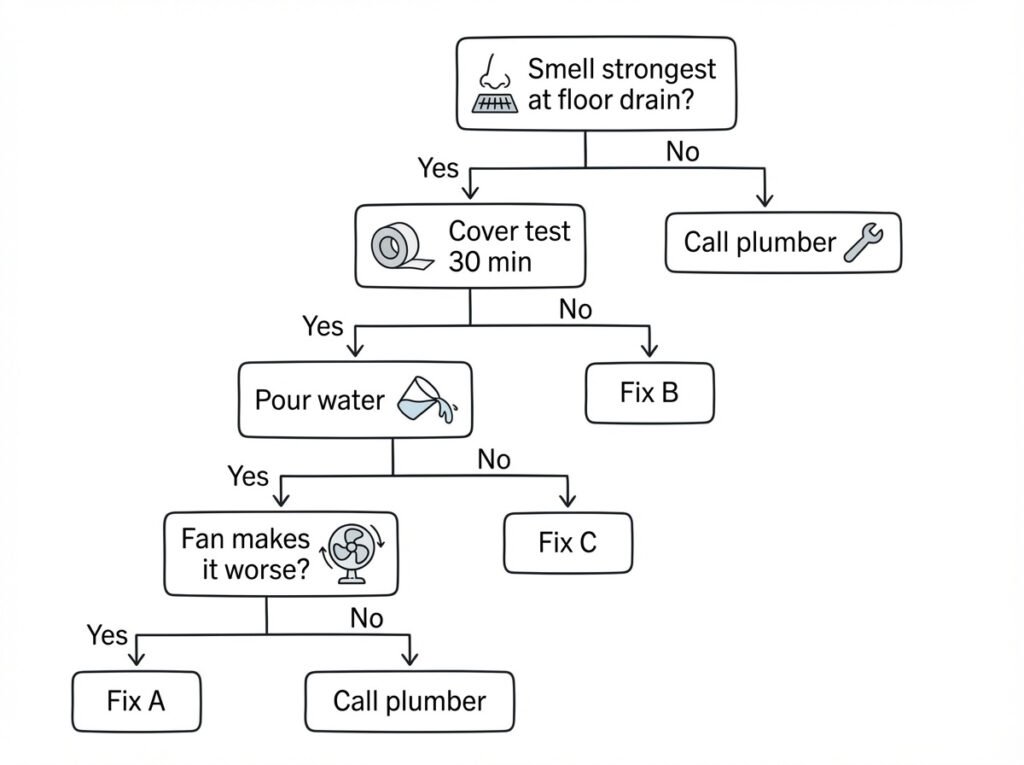
- Smell strongest at floor drain?
- If No → check sink/toilet next .
- If Yes → continue.
- Cover test reduces odor in 30 min?
- If No → likely leak/vent/other fixture → Call plumber.
- If Yes → continue.
- Pour water → odor improves in 2 min?
- If Yes → Fix A: Restore trap seal.
- If No → continue.
- Fan/range hood makes odor worse?
- If Yes → Fix C: Pressure/Vent path checks + plumber.
- If No → Fix B: Clean biofilm.
Fix A (48-hour fix): Restore the trap seal and keep it from drying out
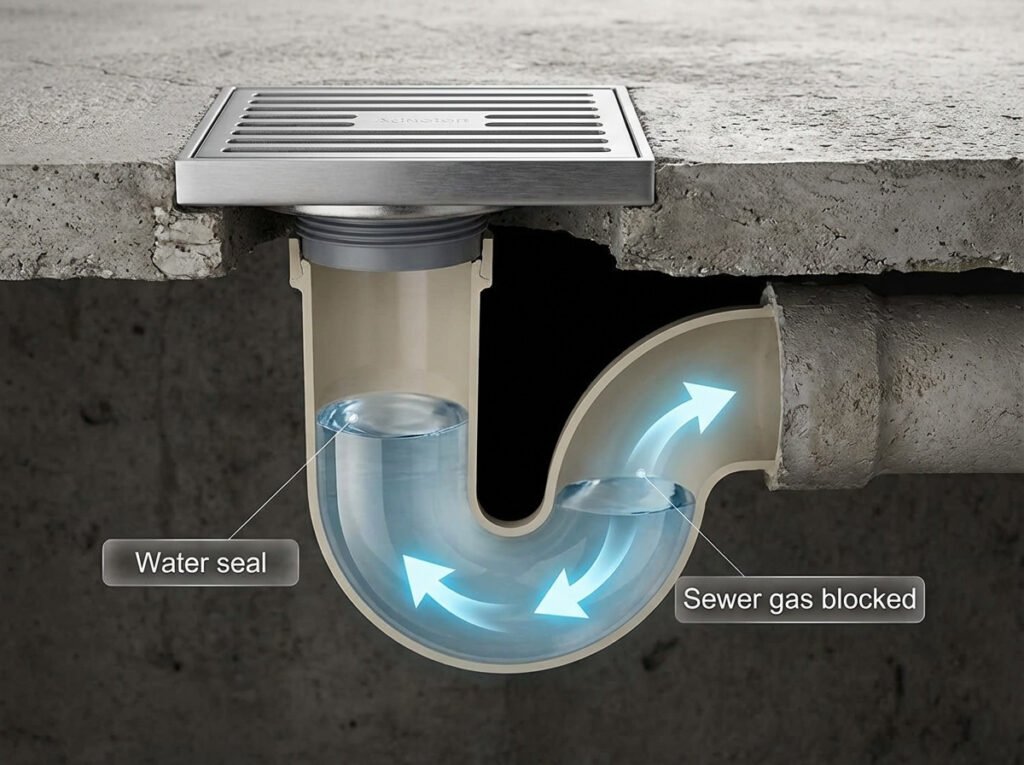
A floor drain is supposed to block sewer gas with a water seal. If it dries out, odor gets in. Public health guidance calls this out directly and recommends adding water.
Step-by-step
- Pour 2–4 cups of water into the drain.
- Wait 2 minutes.
- Smell-check the room again.
- If the odor improves, repeat once more (some drains need a bit more water to restore the seal).
- Record the date. (You’ll use it for prevention.)
Applies: rarely used bathrooms, guest bath, basement floor drain
Not for: persistent odor that never changes after adding water (go to Fix B/C)
Keep the seal from drying out
- Schedule a simple routine: add water once a week to rarely used floor drains.
- If it’s a seasonal home: add water before leaving and again when you return.
Authority consensus: The state public health guidance explicitly recommends flushing floor and sink drains with water to prevent trap drying.
Field-proven tip: Put a recurring reminder on your phone titled “Pour water in guest bath drain.”
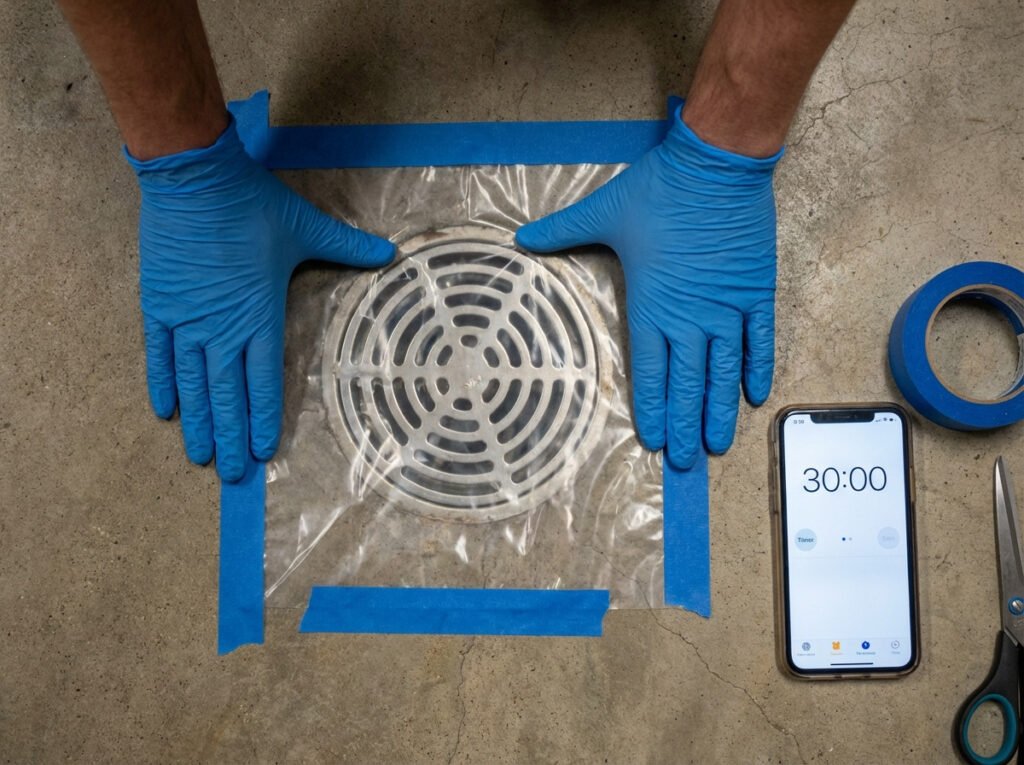
Fix B (48-hour fix): Remove biofilm (the hidden stink layer)
Even with a perfect trap, a drain can smell because organic buildup supports bacteria and produces odor.
Quick clean (no special tools)
- Put on gloves.
- Scrub the inside rim of the drain and just below it with a stiff brush.
- Flush with hot tap water for 30–60 seconds.
- Repeat the scrub + flush once more.
Applies: musty “dirty drain” smell, odor doesn’t change much with added water
Not for: active sewage backup, standing wastewater, or overflow (call a plumber)
Deeper clean (if odor returns in 1–3 days)
- Brush again (the brush does most of the work).
- Rinse thoroughly.
- Restore the trap seal with water (Fix A).
Field-proven tip: If you only pour chemicals without brushing, you often “perfume the slime” instead of removing it.

Fix C: Venting / pressure checks (when smell spikes with fans or wind)
If your exhaust fan or range hood makes the odor worse, your home may be pulling air from the drain path. Public health guidance notes sewer gas can enter through a floor drain and also mentions checking plumbing vents for blockage.
What you can do safely (no ladder required)
- Open a window slightly in the bathroom while the fan runs.
- Crack the bathroom door to provide make-up air.
- Re-test: fan on → does odor drop?
If make-up air helps, you likely have a pressure imbalance. The “real fix” is usually in venting or sealing—not air fresheners.
Applies: odor worsens when fans run, door closed, windy days
Not for: you suspect a blocked roof vent but can’t access it safely—don’t climb; call a pro
When to call a plumber (for Fix C)
Call if any of these are true:
- Cover test points to the drain, but Fix A/B don’t help.
- Odor returns within hours even after cleaning.
- Odor appears in multiple bathrooms at the same time.
- You suspect a vent blockage or a leak behind the wall.
Authority consensus: Public health guidance suggests checking roof vents for debris and hiring a plumber if the leak is behind the wall.
What “sewer gas smell” can mean for health (keep it practical)
Sewer gas is a complex mix. Public health agencies note it can include hydrogen sulfide and ammonia, and also methane.
Hydrogen sulfide can irritate eyes and airways at lower levels and can be dangerous at high concentrations.
If the whole house air feels thick or hard to breathe, use this decision tree to narrow it down fast
Sensitive households (extra caution)
If your home includes:
- asthma/allergies
- immune-compromised family members
- infants, older adults
treat persistent odors as a higher priority. If you can’t quickly identify and stop the entry point, book a plumber and limit exposure.
Field-proven tip: Don’t “power through” odors in a closed bathroom. Short exposures add up, and you lose objectivity.
30-day prevention plan (so it doesn’t come back)
Weekly (2 minutes)
- Pour 2 cups of water into rarely used floor drains.
Applies: guest bath, basement drain, seasonal home
Not for: drains that refill with wastewater (possible backup)
Monthly (10 minutes)
- Brush the drain rim and flush with hot water.
Applies: any drain that develops “dirty drain” odor
Not for: if you see corrosion, cracks, or loose drain body (call a plumber)
For more low-cost ways to improve indoor air without buying big equipment, start here
After big exhaust events (kitchen hood party, long hot shower)
- Open a window slightly or crack the door to reduce negative pressure.
Applies: odor spikes with fans
Not for: outdoor smoke events or poor outdoor air quality (use other ventilation strategies)
If your home still feels stuffy even with windows open, this guide explains what’s really happening
FAQ
Why does my floor drain smell even if I clean the bathroom?
Because the odor often comes from inside the drain system, not from surfaces you wipe. A dry trap seal or biofilm are the usual suspects.
The smell is “rotten egg.” Is that dangerous?
It can be. Rotten egg odor is commonly associated with hydrogen sulfide. At low levels it can irritate; at high levels it can be very dangerous. If the smell is strong or you feel symptoms, leave and get fresh air.
I poured water and it helped, but the smell came back in a week. Why?
Your drain likely dries out (rarely used) or you have a pressure/venting issue. Follow Fix A prevention and run Test 3.
When should I stop DIY and call a professional?
If Fix A and Fix B fail, if multiple fixtures smell, if odor spikes with fans, or if you feel symptoms. Public health guidance explicitly recommends hiring a plumber when the source is behind the wall.
Authority consensus statements are explicitly tagged and backed by:
U.S. Environmental Protection Agency mold/moisture guidance (for broader home moisture red lines).
Wisconsin DHS sewer gas page for entry points, actions, and hazards.
Author Trust Block
Written by: WellZenx Editorial Team
Reviewed by: Home Environment Standards Editor (WellZenx)
Editorial standards: This article follows our Editorial Policy and fact-checking process.
Medical disclaimer: This content is for general education and does not replace medical advice.
Last updated: January 30, 2026
Related pages: Editorial Policy • Corrections • Medical Disclaimer • About WellZenx