
Find the Hidden Source Fast + Fix It for Good
Published: February 14, 2026 (ET)
Updated: February 14, 2026 (ET)
That “urine” or sharp ammonia smell in a bathroom is usually not coming from the air.
It’s coming from a small, hidden reservoir that keeps re-releasing odor.
Most cases fall into one (or more) of these buckets:
- Surface reservoir (toilet base, grout, caulk, bath mat, trash can)
- Drain / sewer-gas path (dry P-trap, floor drain, sink overflow, plumbing vent issues)
- Product or chemical odor (ammonia-based cleaner, bleach misuse, fragrances layering)
Don’t keep spraying.
Test the source. Fix the source. Then prevent the rebuild.
Quick Safety Rules (Read Once)
- Never mix bleach with ammonia or any other cleaner.
- Ventilate while using cleaning products. Open a window or run the fan to reduce fumes.
- If anyone feels dizzy, nauseated, or gets strong throat/eye irritation during cleaning, stop and ventilate.
If odors frequently trigger symptoms, also read Can Poor Indoor Air Quality Cause Headaches and Fatigue?
The WellZenx “Urine/Ammonia Odor Map”
Use this when the smell returns within hours or days.
Goal: identify the one zone that is feeding the odor.
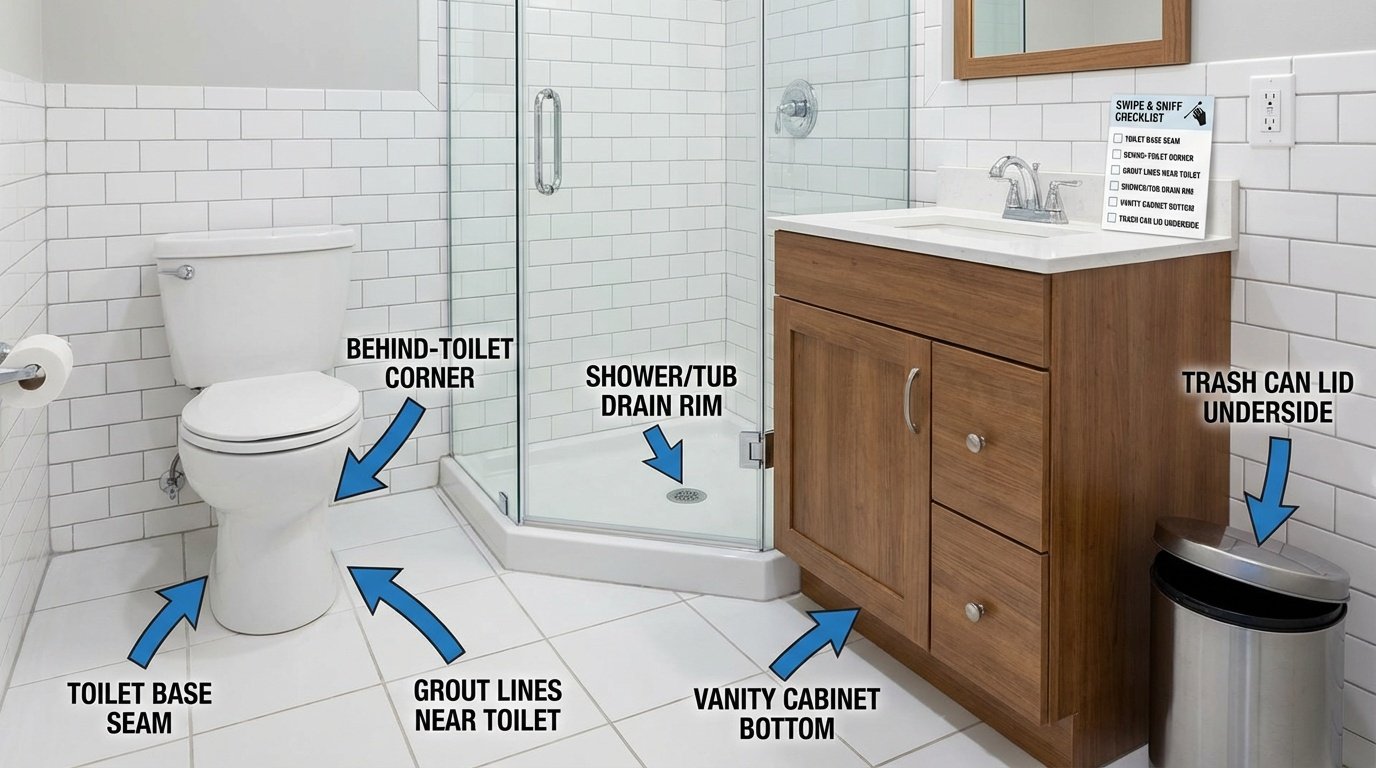
Step 1 — Do a 60-second smell map
Do one slow sniff in each spot. Don’t “deep inhale.”
- Toilet base (right where porcelain meets the floor)
- Behind the toilet (wall + floor corner)
- Vanity cabinet (open doors, sniff low)
- Shower/tub drain area (sniff near the drain)
- Bathroom trash can (lid underside if it has one)
Step 2 — Run the 3 “Swipe & Sniff” confirm tests (6 minutes)
Use a white paper towel dampened with warm water + a drop of mild soap.

Test A — Toilet Base Ring Wipe (2 minutes)
- Wipe the floor seam around the toilet base.
- Focus on the back half (hardest to see).
- Smell the towel.
If the towel smells like the bathroom odor: your source is likely splash + residue + porous grout/caulk.
Test B — Grout/Caulk Corner Wipe (2 minutes)
- Wipe one grout line near the toilet and one caulk edge near the tub.
- Smell the towel.
If grout/caulk smells strongest: odor is living in porous seams.
Test C — Drain Rim Wipe (2 minutes)
- Wipe the drain rim (shower/tub or sink).
- Smell the towel.
If drain rim smells sour/sewer-ish: treat as drain biofilm or dry-trap odor.
If the smell is mostly “drain-like,” jump to Shower Drain Smells? 10-Minute Tests + Fixes That Actually Work or Bathroom Floor Drain Smells? Fix Sewer Odor in 10 Minutes(And Keep It From Coming Back).
Step 3 — Score the likely source (0–10)
Add points. Then use the fix path below.
- Toilet base wipe smells like the odor (+4)
- Grout/caulk wipe smells like the odor (+2)
- Trash can lid/bottom smells like the odor (+2)
- Drain rim wipe smells like the odor (+2)
0–2: mild → quick clean + dry routine
3–6: moderate → targeted deep clean + one seal/repair step
7–10: heavy → 48-hour reset + repair (wax ring/caulk/drain trap)
Step 4 — Make a 30-second log (so you can repeat what works)
- Odor type: urine/ammonia OR sour/sewer OR musty
- Strongest zone: toilet base / grout / drain / trash / cabinet
- What fixed it most: clean / enzyme / seal / drain reset / other
What That Smell Usually Means (Plain English)
A urine/ammonia smell often comes from tiny deposits that keep getting re-wet by humidity.
Bathrooms are warm and damp. Odor reservoirs “wake up” fast.
A sewer-ish smell is different.
That’s usually drain gas or drain biofilm, not toilet residue.
If you’re unsure, your Swipe & Sniff tests separate them.
10-Minute Checks (Do These Before You Deep-Clean)
Check 1 — Rule out “product odor” (1 minute)
Ask one question:
Did you recently switch cleaners?
Some cleaning products emit VOCs, and indoor VOC levels can be higher than outdoors.
If you’ve been layering sprays, stop them for 48 hours and re-test the room.
If air feels heavy during cleaning, read Air Feels Thick to Breathe Indoors: Humidity vs Stale Air vs Irritants (10-Minute Checks).
Check 2 — The toilet base is guilty until proven innocent (2 minutes)
Most persistent “urine” odors are the toilet base zone.
Not because you’re dirty—because it’s a perfect trap.
Do the Toilet Base Ring Wipe again and smell the towel.
If it hits hard, go straight to Fix Path A.
Check 3 — Look for the “hidden splash triangle” (3 minutes)
Check:
- Back of toilet base
- Floor behind toilet
- Bottom of vanity side panel nearest the toilet
That triangle catches micro-splashes that never get wiped.
Check 4 — Drain sanity check (4 minutes)
If the odor is sharp but also sour/sewer-ish:
- Run water 20–30 seconds in the sink and shower.
- If you have a floor drain, pour in a cup or two of water.
Dry traps can allow odor. Moisture control matters for odor and microbial growth.
For a non-bathroom version of the same logic, see Dry-Area Floor Drain Smells? 10-minute tests + fixes that last.
Fix Paths (Pick the Path That Matches Your Tests)
Fix Path A — Toilet Base / Floor Seam Reservoir (Most common)
Choose this if the Toilet Base Ring Wipe smelled like the odor.
Do this now (10–15 minutes)
- Remove soft items first. Pull the bath mat and towels. Bag them for washing.
- Clean the base ring. Use warm soapy water. Scrub the floor seam around the toilet.
- Rinse wipe. Wipe again with clean water.
- Dry hard. Towel-dry the seam and floor.
If the smell returns fast (same day or next day):
You may have residue under the toilet edge or a seal issue (wax ring / micro-leak). That’s when you escalate to inspection/repair.

Fix Path B — Grout/Caulk Holds Odor (Porous seams)
Choose this if grout/caulk wipes smelled strongest.
Do this now (10–20 minutes)
- Scrub seams with warm soapy water and a small brush.
- Rinse with clean water.
- Dry fully.
If caulk is cracked or lifting: reseal/replace.
Odor will keep returning if moisture keeps entering the seam.
Fix Path C — Drain Biofilm or Sewer-ish Odor
Choose this if the drain rim wipe smelled sour/sewer-ish.
Start with your drain articles:
- Shower Drain Smells? 10-Minute Tests + Fixes That Actually Work
- Bathroom Floor Drain Smells? Fix Sewer Odor in 10 Minutes(And Keep It From Coming Back)
Then come back and re-check the toilet base. Many bathrooms have two sources.
Fix Path D — Trash Can / Hidden Trash Reservoir
Choose this if trash can lid/bottom smells strongest.
- Wash the bin.
- Scrub lid underside.
- Rinse.
- Dry completely (drying stops odor rebuild).
If your trash smell “bursts” when you open it, your kitchen article applies too: Trash Can Smell Explodes When You Open the Lid.
The 48-Hour “No Urine Smell” Reset (Works for Stubborn Cases)
Hour 0–2 (Today): Remove reservoirs, then dry
- Wash bath mats and towels hot (as allowed by the label).
- Clean the toilet base ring and behind-toilet floor corner.
- Clean the trash can lid underside.
- Run the bathroom fan 30–60 minutes to dry the room.
If you use any strong cleaners, remember: don’t mix products, and ventilate.
Hour 2–24 (Tonight): Keep it dry and simple
- Keep the bath mat off the floor overnight if it holds odor.
- Leave the shower curtain/door open after use so surfaces dry.
- Avoid fragrance sprays for one full day (they can mask whether your fix worked).
Hour 24–48 (Tomorrow): Re-test and decide if repair is needed
- Repeat the Toilet Base Ring Wipe and smell the towel.
- If it’s still strong, inspect for:
- a loose toilet
- staining that keeps returning
- moisture around the base
If you suspect ongoing moisture, treat it like a moisture-control problem. EPA emphasizes moisture control as key to preventing mold and related issues.
If you’re dealing with mustiness too, read Musty Smell Inside Kitchen Cabinets (Counters Look Clean) (same moisture logic, different location).

30-Day Prevention (So It Doesn’t Come Back)
Weekly (5 minutes)
- Wipe the toilet base seam and behind-toilet floor corner.
- Wash bath mats/towels on a routine.
- Empty and wipe the trash can if it holds odor.
After showers (30 seconds)
- Run the fan.
- Open the shower curtain/door so surfaces dry.
CDC recommends keeping indoor humidity as low as you can—no higher than 50%—and fixing leaks so mold doesn’t have moisture to grow.
EPA suggests keeping indoor humidity below 60% (ideally 30–50%).
Stop accidental chemical odors
- Don’t layer multiple products.
- Don’t “top off” bleach with other cleaners.
For broader low-cost air and odor habits, read How to Improve Indoor Air Quality Without Expensive Equipment.
When to Escalate
Escalate if:
- The smell returns within 24 hours after cleaning and drying.
- You see recurring moisture at the toilet base.
- The odor is clearly sewer-gas-like and persists after running water in drains.
- Anyone has frequent symptoms linked to the bathroom environment.
FAQ
Q1: Why does my bathroom smell like urine even after cleaning?
Because the odor is usually trapped at the toilet base seam, grout, caulk, or fabrics—not on the visible surfaces you wipe.
Q2: What’s the fastest test to find the source?
Do the Toilet Base Ring Wipe and smell the towel. It catches most persistent cases.
Q3: Could the smell be from cleaners?
Yes. Some products emit VOCs, and indoor VOC levels can be higher than outdoors.
Stop fragrance layers for 48 hours and re-test.
Q4: Is it safe to use bleach for this?
Use it carefully, and never mix it with ammonia or other cleaners.
Ventilate during use.
Q5: The smell is sewer-ish, not urine. What then?
Treat it as a drain problem. Start with Shower Drain Smells? 10-Minute Tests + Fixes That Actually Work.
Q6: Why does it get worse in humid weather?
Humidity reactivates residues and slows drying. CDC and EPA recommend keeping indoor humidity controlled.
Author Trust Block
Written by: WellZenx Editorial Team
Reviewed by: Home Environment Standards Editor (WellZenx)
Editorial standards: This article follows our Editorial Policy and fact-checking process.
Why trust this: This guide is built specifically for persistent bathroom urine/ammonia odors using a repeatable source-finding workflow (smell mapping + three swipe-and-sniff confirm tests + a 0–10 source score) to separate surface residue at the toilet base/seams from drain-related odors and product-related fumes. Safety and prevention steps align with CDC guidance to never mix bleach with ammonia/other cleaners and to ventilate during use, plus EPA guidance that VOC levels can be higher indoors and that moisture control/humidity targets reduce odor and microbial growth risk.
Medical disclaimer: This content is for general education and does not replace medical advice.
Last updated: February 14, 2026
Related pages: Editorial Policy • Corrections • Medical Disclaimer • About WellZenx