
Hidden Moisture Checks + 48-Hour Dry-Out Plan
Published: February 13, 2026 (ET)
Updated: February 13, 2026 (ET)
Kitchen cabinets can look spotless and still smell musty.
That smell usually means moisture is getting in and not drying out.
Don’t chase the odor with sprays.
Find the wet spot. Dry it fast. Keep it dry.
Quick Triage (60 seconds)
Answer these with a quick sniff.
- Only smells when you open the cabinet?
Likely trapped moisture inside the box. - Strongest under the sink?
Think micro-leak, damp towel/sponge, or slow plumbing seep. - Strongest near the dishwasher?
Think steam leaks, damp insulation, or a wet toe-kick zone. - Smell spikes after rain or high humidity days?
Think hidden intrusion or humidity-driven condensation.
If your whole home smells musty (not just cabinets), read House Smells Musty but No Visible Mold: A 15-Minute Check + 48-Hour Reset.
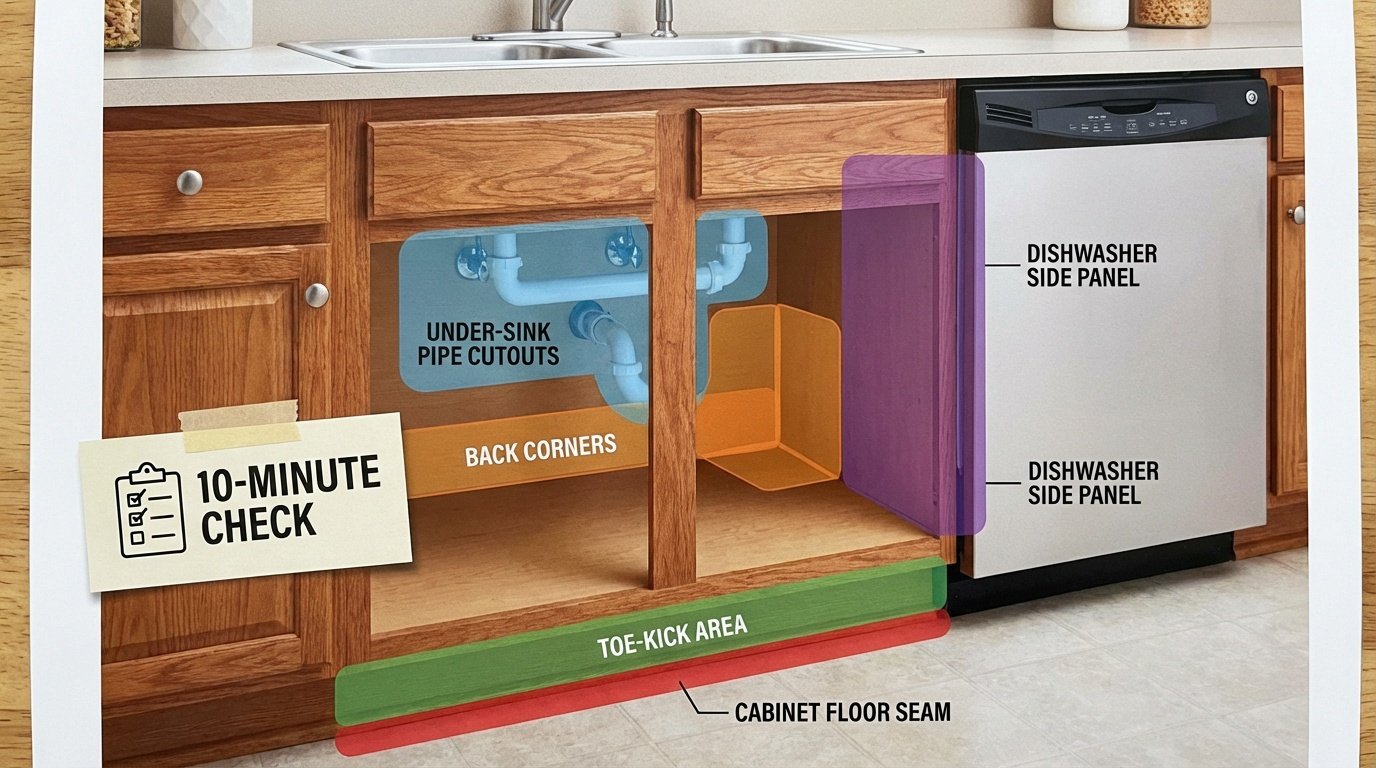
The WellZenx Cabinet Moisture Pin-Map
Use this when cabinets smell musty but you can’t see mold.
This takes 10 minutes. It finds the moisture zone fast.
Step 1 — Map the smell (2 minutes)
Open one cabinet at a time.
Smell once.
Close it.
Move on.
Rank your top 3 “worst” cabinets.
Mark them as #1, #2, #3.
Most people guess wrong.
This stops the guessing.
Step 2 — Do the 5 “Hidden Moisture” checks (8 minutes)
Do these only in your top 3 cabinets.
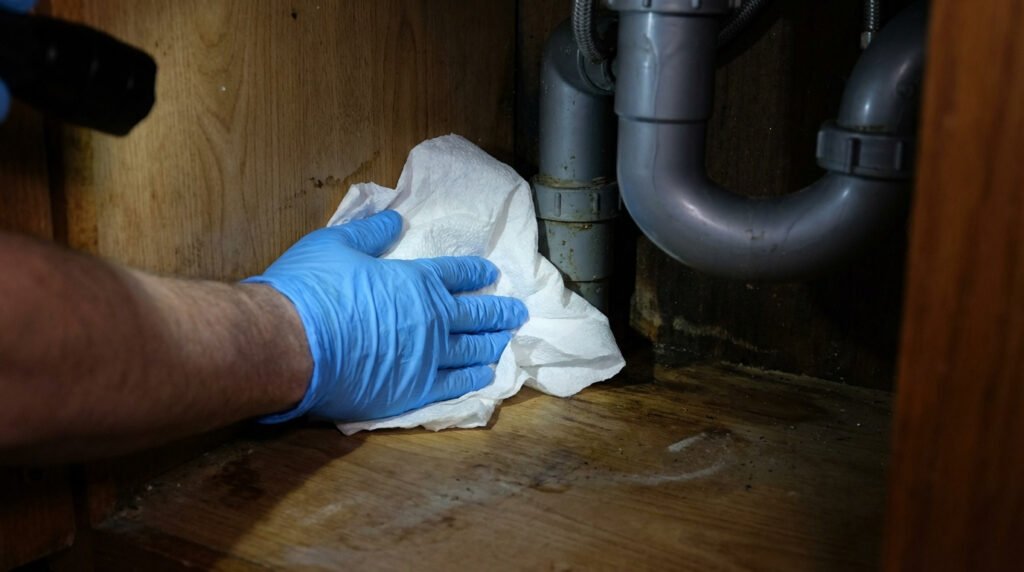
Check A — Paper-Towel Press Test (60 seconds)
Press a dry paper towel into:
- the back corner
- the floor seam
- around the pipe cutouts (if under sink)
If the towel comes back damp or discolored, you found active moisture.
Check B — Flashlight Seam Scan (90 seconds)
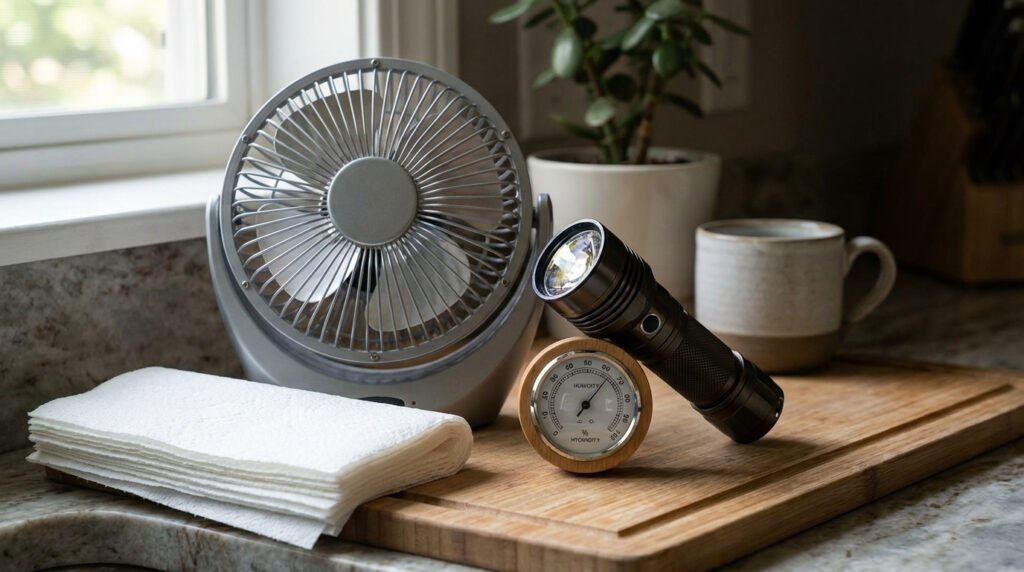
Use a flashlight.
Look at:
- the bottom corners
- the back panel edge
- the toe-kick gap (below the cabinet front)
Look for dark staining, swollen edges, or fuzzy growth.
Check C — “Back Panel Tap” (60 seconds)
Tap the back panel with your knuckle.
Listen for a dull, soft sound (water-damaged particleboard).
Press lightly.
If it feels spongy, the material may be holding moisture.
Check D — Dish-Dryer/Steam Clue (60 seconds)
If the musty cabinet is next to the dishwasher:
Run a hot cycle.
Wait 10 minutes.
Open the adjacent cabinet.
If the smell spikes, steam/moisture is likely entering that cavity.
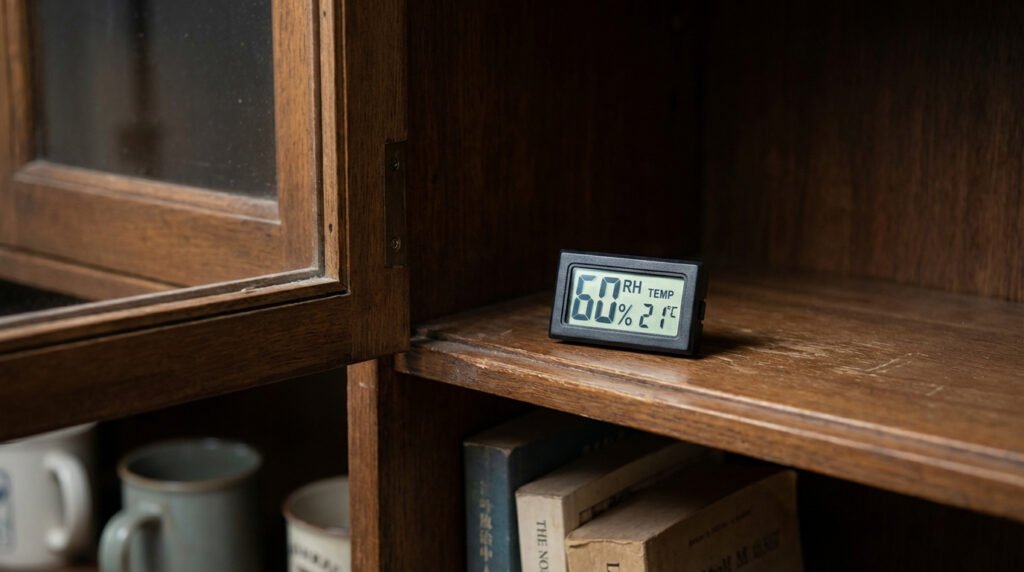
Check E — Mini Humidity Snapshot (2 minutes)
Put a small hygrometer inside the cabinet.
Close the door for 10 minutes.
Check the reading.
If the cabinet RH stays high compared to the room, moisture is trapped.
CDC recommends keeping indoor humidity no higher than 50% to help prevent mold.
EPA notes indoor humidity should be kept below 60% (ideally 30–50%).
If you don’t have a hygrometer yet, you’ll use it for other articles too—especially Is High Indoor Humidity Bad for Your Health?
What “Musty” Usually Means in Cabinets
Musty odor is not random.
It’s a pattern:
- Moisture shows up (leak, steam, condensation).
- Airflow is low (closed box).
- Materials hold water (particleboard, MDF, paper liners).
- Odor builds.
Drying speed matters a lot.
EPA’s mold guidance says if wet or damp materials are dried within 24–48 hours, in most cases mold will not grow.
That’s your target window.
10-Minute Cabinet Checks (Do These Before You Clean Anything)
Check 1 — Remove “odor sponges” (2 minutes)
Pull out:
- shelf liners
- paper goods
- spice boxes
- towels and cleaning cloths
Smell them.
If they smell musty, bag them and remove them now.
Porous materials can hold mold and odor and can be hard to fully clean.
Check 2 — Find the water path (3 minutes)
Follow the most likely route.
- Under sink: check trap, shutoff valves, supply lines
- Dishwasher side: check toe-kick area and side panels
- Exterior wall cabinet: check for cold-wall condensation points
No leak visible doesn’t mean no leak.
Micro-leaks can evaporate and still feed odor.
Check 3 — Check for condensation triggers (2 minutes)
Ask: “When is it worst?”
- Right after running dishwasher?
- After boiling water or heavy cooking (steam load)?
- After rain or humid days?
If steam/humidity is a regular trigger, read How to Improve Indoor Air Quality Without Expensive Equipment (focus on source control + venting).
Check 4 — Decide: clean vs replace (3 minutes)
Look at the cabinet floor and back panel.
- If wood is swollen, crumbly, or permanently warped, replacement may be necessary.
- EPA notes absorbent/porous materials can be difficult or impossible to fully remove mold from, and may need to be thrown away if moldy.
Fix Paths (Pick the One That Matches Your Checks)
Fix Path A — Active leak (under sink is #1)
Choose this if paper towel came back damp.
Do this now
- Tighten the obvious loose fitting if it’s safe.
- Stop using that sink if water is actively dripping.
- Dry the cabinet floor immediately.
Then do this
- Run the 48-hour dry-out plan below.
If you keep getting leaks after rain or storms, you may also need the broader moisture playbook: Musty Smell After Rain: Find the Moisture + 48-Hour Dry-Out.
Fix Path B — Dishwasher steam/moisture
Choose this if smell spikes after a hot cycle.
Do this now
- Pull the toe-kick (if easy).
- Feel for dampness on the floor.
- Check the cabinet side panel next to the dishwasher.
Do this next
- Let the dishwasher door crack open after cycles for a week (if safe).
- Improve kitchen exhaust use during cooking (less steam load overall).
Fix Path C — Humidity/condensation in a closed box
Choose this if cabinet RH is high but no leak is found hint.
Do this now
- Remove shelf liners and clutter.
- Increase airflow for 48 hours.
- Lower humidity in the room.
CDC recommends fixing leaks and controlling humidity so mold does not have moisture to grow.
EPA also emphasizes moisture control as the key to mold control.
Fix Path D — “Old smell” trapped in liners/contents
Choose this if the cabinet box itself smells mild, but liners/boxes smell strong.
Do this now
- Replace liners.
- Wash towels.
- Store paper goods in sealed bins for 2 weeks.
The 48-Hour Cabinet Dry-Out Plan (Simple, Effective)
Your goal: dry everything inside that cabinet within 24–48 hours.
Hour 0–2 (Today): Stop water + strip the cabinet
- Empty the cabinet completely.
- Pull out shelf liners.
- Wipe any visible moisture.
- Leave doors wide open.
If you use cleaners: ventilate.
If you use bleach: never mix it with other cleaners, and try not to breathe fumes.
Hour 2–24 (Tonight): Move air + remove moisture
- Aim a fan across the cabinet opening (not directly into the back corner).
- Run a dehumidifier in the kitchen if RH is high.
- Recheck with paper towel press test before bed.
Target humidity: as low as practical.
CDC says keep it ≤50% to help prevent mold.
EPA suggests below 60%, ideally 30–50%.
Hour 24–48 (Tomorrow): Clean the hard surfaces (only after it’s dry)
If the cabinet is dry and you see light surface growth or smell persists:
- Scrub hard surfaces with detergent and water.
- Dry completely.
EPA’s mold guidance recommends scrubbing mold off hard surfaces with detergent and water and drying completely.
If the cabinet floor is swollen or crumbling, treat it as damaged material. Replace the panel if needed.
30-Day Prevention (So It Doesn’t Come Back)
Weekly (2 minutes)
- Do a quick smell check under the sink.
- Wipe the cabinet floor seam.
- Keep the cabinet from becoming storage-packed.
Monthly (5 minutes)
- Recheck cabinet RH with a hygrometer.
- Inspect pipe joints and shutoff valves for slow drips.
Habit upgrades that work
- Keep sponges and wet towels out of closed cabinets.
- Let the dishwasher and sink area dry out after heavy use.
- Use kitchen exhaust when cooking to reduce humidity load.
If you keep dealing with musty odors despite drying, read Why Does My House Smell Musty Even After Cleaning? and House Smells Musty but No Visible Mold: A 15-Minute Check + 48-Hour Reset.
When to Escalate
Escalate if any of these are true:
- The cabinet material is swollen/soft and won’t dry.
- Musty smell returns within days even after a full dry-out.
- You see widespread visible growth.
- Anyone in the home has persistent symptoms you suspect are triggered by the space.
FAQ
Q1: Why do my cabinets smell musty but look clean?
Because moisture can sit in seams, back corners, and toe-kick areas where you don’t see it. Odor can build without visible mold.
Q2: How fast do I need to dry a wet cabinet?
EPA guidance says drying wet or damp areas within 24–48 hours helps prevent mold growth in most cases.
Q3: What humidity should I aim for to prevent musty smells?
CDC recommends keeping indoor humidity no higher than 50%.
EPA suggests keeping it below 60%, ideally 30–50%.
Q4: Should I use bleach inside cabinets?
Often you don’t need it. Start with cleaning (soap/detergent + water) and drying. EPA emphasizes moisture control and cleaning hard surfaces with detergent and water, then drying completely.
If you do use bleach, never mix it with other cleaners and ventilate.
Q5: The smell is strongest after the dishwasher runs—why?
Steam and warmth can push moisture into adjacent cavities. Dry out the toe-kick area, improve venting, and keep the dishwasher door cracked after cycles (if safe).
Q6: When do I replace cabinet parts instead of cleaning?
If particleboard/MDF is swollen, soft, or crumbling, it may hold moisture and odor. EPA notes porous materials can be difficult or impossible to fully clean if moldy.
Author Trust Block
Written by: WellZenx Editorial Team
Reviewed by: Home Environment Standards Editor (WellZenx)
Editorial standards: This article follows our Editorial Policy and fact-checking process.
Why trust this: This article uses a cabinet-specific moisture diagnostic workflow (smell mapping + paper-towel press checks + seam flashlight scan + in-cabinet RH snapshot) to identify whether odor is driven by an active leak, dishwasher steam intrusion, or trapped humidity inside a closed cabinet box. Dry-out timing and targets follow EPA mold/moisture guidance (dry wet materials within 24–48 hours and keep indoor humidity controlled), and cleanup steps mirror EPA’s recommended approach for hard surfaces (detergent + water, then dry completely).
Medical disclaimer: This content is for general education and does not replace medical advice.
Last updated: February 13, 2026
Related pages: Editorial Policy • Corrections • Medical Disclaimer • About WellZenx