
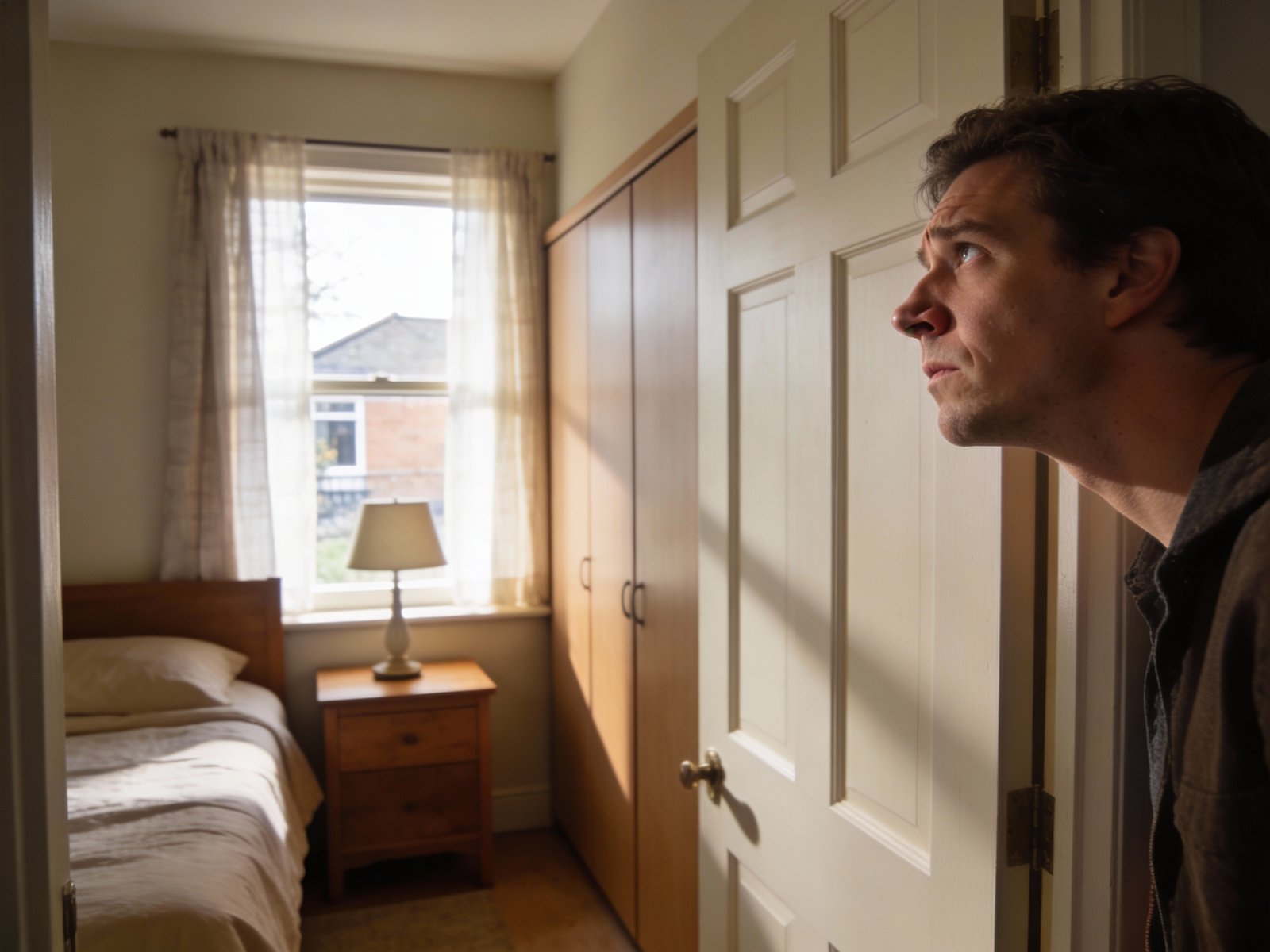
By: WellZenx Editorial Team
Published: January 25, 2026 (ET)
Updated: March 1, 2026 (ET)
Quick answer:
If one room smells musty but the rest of the house doesn’t, the cause is usually local: a cold exterior corner (condensation), a closet/fabric “odor reservoir,” a small re-wetting seam, or a room-specific airflow issue. Use the 10-minute source check below—if the smell improves but returns within 48 hours, a moisture trap is still active.If one room smells musty but the rest of the house doesn’t, the cause is usually local and you can pinpoint it fast with the checks below.
If your home smells musty in multiple areas (not just one room), start with this musty smell checklist.
Scope guardrails (what this covers)
One scenario only: one room smells musty, while the rest of the home is mostly fine. This guide helps you pinpoint the source quickly and choose fixes you can verify with simple clues.
Not covered (separate situations)
- Flooding, sewage backup, or contaminated water exposure
- Large-area visible mold growth or repeated wetting you can’t locate
- Strong gas smell, CO alarm, severe dizziness or breathing distress
30-Second Quick Pick (choose the most accurate description)
Pick the line that matches your room. You’ll use the matching path below.
A) The musty smell is strongest near a window/exterior wall, especially after cool nights
B) The smell is strongest near the closet, hamper, rugs, or soft furniture
C) The smell spikes after rain, after AC runs, or after a shower elsewhere in the home
D) The room is fine with the door open, but gets musty overnight with the door closed
E) You can’t locate it, but it’s worse in the morning or after the room has been closed
If the musty smell started right after you returned from a trip, use this musty-after-vacation reset.
One Room Smells Musty: 10-Minute Source Check (No Special Gear)
This 10-minute source check is designed for when one room smells musty and you need a clear starting point.
Minimum tool kit
Flashlight
Paper towels
Painter’s tape (or sticky notes)
Disposable gloves
Optional: a small hygrometer (nice-to-have, not required)
Step 1: Make a “smell map” (2 minutes)
Stand in the room and do a quick sniff check in four spots:
- Doorway (as you enter)
- Window/exterior wall corner
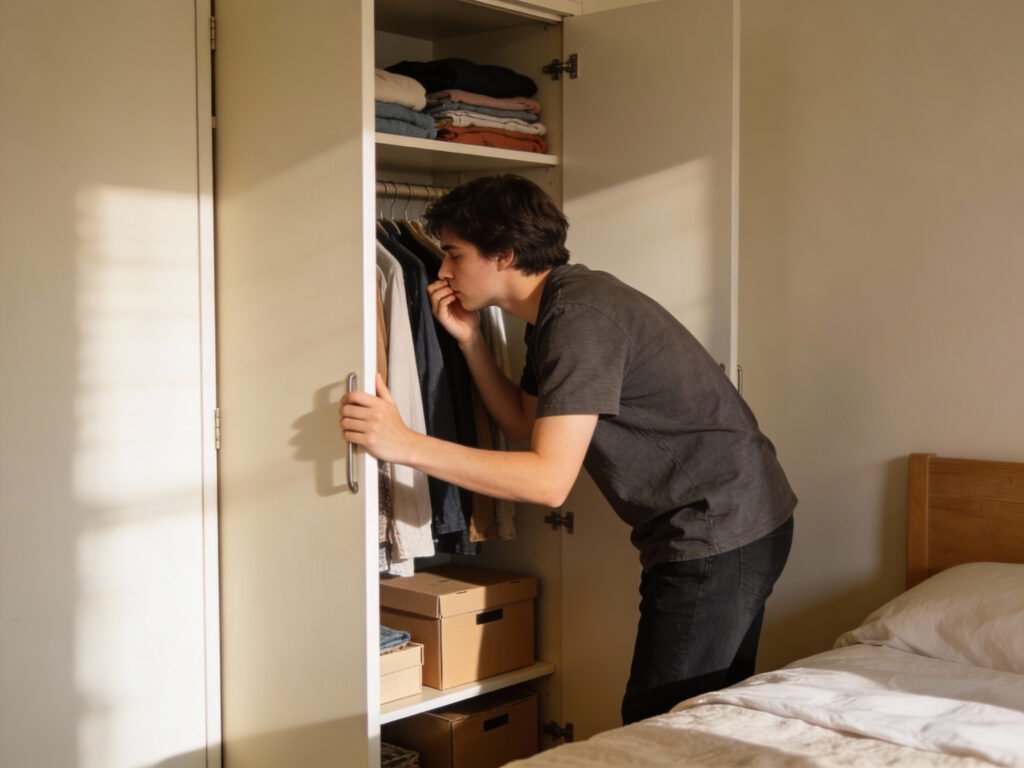
- Closet (open the door and sniff inside)
- Low spot near baseboards (especially under windows)
Circle the strongest “smell zone.” That’s your starting point.
Step 2: Fabric puff test (2 minutes)
In the strongest smell zone, do one quick check:
- Open the closet or pull back a curtain/rug edge and smell the air “puff”
If the musty smell spikes immediately, the source is often stored moisture in fabrics or backing materials.

Step 3: Paper towel swipe + tape mark (3 minutes)
Choose one suspicious spot (baseboard seam, window corner, closet back wall).
- Swipe with a dry paper towel along the seam or surface
- If you get any dampness, discoloration, or “earthy” smell on the towel, mark the exact spot with tape
This creates a repeatable “wet clue” you can re-check in 24–48 hours.
Step 4: Door-closed overnight clue (3 minutes)
Close the door for 10 minutes while you do something nearby, then re-enter.
- If it’s noticeably worse after being closed, that points to stagnant air + a small local source (often closet/fabrics or a cold exterior corner).
What’s Usually Causing a Single-Room Musty Smell (and how to confirm)
Cause 1: Cold-surface condensation (common on exterior walls/windows)
Why it happens: Warm indoor air hits a colder surface and condenses in corners, behind furniture, or on window frames.
Confirm with clues:
- Stronger smell near the exterior wall/window
- Worse after cool nights
- A corner behind a dresser or bed feels slightly damp or “cooler than expected”
What it’s not: This usually isn’t a whole-home humidity problem unless multiple rooms show the same pattern.
Cause 2: Hidden moisture in fabrics/materials (closet, rug backing, hamper, upholstered items)
Why it happens: Fabrics and porous materials hold moisture and odors, especially with poor airflow.
Confirm with clues:
- Smell “puff” when opening closet/hamper
- Strongest smell is inside a storage zone, not the open room air
- Smell improves quickly after removing or airing items
Cause 3: One-time water intrusion that keeps re-wetting (rain-driven leak, minor plumbing seep)
Why it happens: A small entry point reactivates after weather or usage, keeping a seam or backing damp.
Confirm with clues:
- Musty spikes after rain
- Your tape-marked spot shows repeated dampness after 24–48 hours
- Baseboard seam or window corner is consistently the hot spot
Cause 4: HVAC distribution issue (the room is “fed” by stale air or trapped air)
Why it happens: The room doesn’t exchange air well, so a small odor source becomes noticeable.
Confirm with clues:
- Much better with the door open
- Worse overnight with the door closed
- Air feels stale even if the rest of the home is okay
If the air also feels heavy or hard to breathe, compare humidity vs stale air vs irritants here.
Fix Options (pick the one that matches your cause)
Option A: Condensation corner reset (best for exterior-wall corners)
Once you know why one room smells musty, pick the matching fix option below instead of trying everything.
When to use: Cause 1 clues match.
Do this:
- Pull furniture 3–6 inches away from exterior walls to break the cold “dead pocket”
- Dry the corner thoroughly and keep airflow moving across it
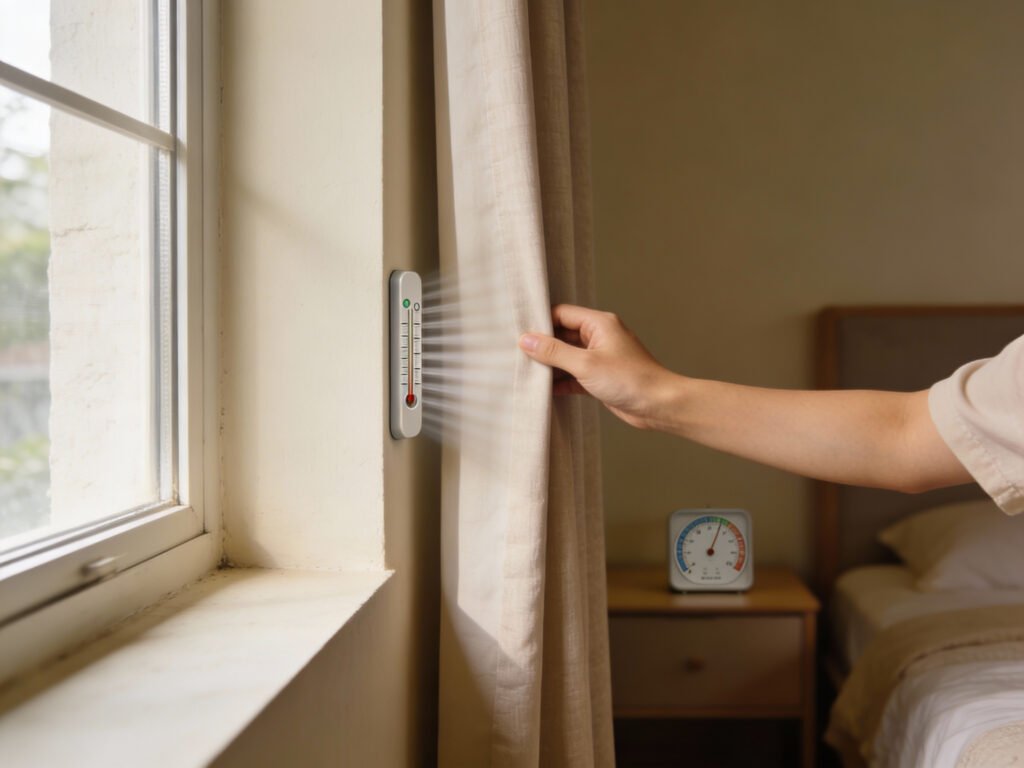
- If the window area is the hot spot, keep blinds from sealing the area shut overnight
Pros: Fast and cheap
Cons: May return during seasonal cold snaps
Cost: Low
Time: 24–48 hours
Risk: Low
Option B: Fabric reservoir cleanup (closet/rug/hamper)
When to use: Cause 2 clues match (closet puff, rug edge smell).
Do this:
- Remove the top 3 suspect items (hamper, a rug, a stack of stored clothes) from the room for 48 hours
- Vacuum and wipe the closet floor and baseboards
- Improve closet airflow (door open for part of the day; avoid overpacking)
Pros: Often the biggest single-room win
Cons: Requires some sorting
Cost: Low
Time: 1–2 days
Risk: Low
Option C: 48-hour “wet clue” chase (for suspected intrusion)
When to use: Cause 3 clues match (rain-linked or recurring damp mark).
Do this:
- Re-check your tape-marked spot at 24 and 48 hours
- If it’s damp again, stop cosmetic cleaning and focus on the entry path (window seam, baseboard line, roof/flashings above)
Pros: Prevents endless re-smelling after superficial cleaning
Cons: May require professional inspection
Cost: Low–High (depends on repair)
Time: 2–7 days
Risk: Medium if ignored
Option D: Air-path fix (for door-closed mustiness)
When to use: Cause 4 clues match (worse with door closed).
Do this:
- Sleep/test with the door open for one night (if practical)
- Use a fan to push air out of the room toward the hallway for 30–60 minutes before bed
- Clear vent and airflow blocks (curtains/furniture)
Pros: Improves stale air quickly
Cons: Doesn’t fix a true moisture source by itself
Cost: Low
Time: 1–2 days
Risk: Low
Targets and escalation points (so you know if it worked)
- If the smell is caused by a local reservoir or condensation: you should notice improvement within 48 hours
- If there is a recurring wet clue: by 48 hours you should know whether the spot re-wets (yes/no)
- If no improvement after 7 days of targeted steps: treat it as hidden intrusion/HVAC distribution and escalate
- If you see expanding visible mold, repeated dampness you can’t locate, or sensitive occupants react: escalate immediately
7-Day “Single-Room Musty” Plan (minimal, not a template wall)
Day 1: Smell map + pick the strongest zone
Goal: identify one “smell zone,” not five guesses
Day 2: Fabric reservoir test (remove top suspects for 48 hours)
Goal: smell drops noticeably if fabrics are the driver
Day 3: Tape-mark re-check (24 hours)
Goal: confirm whether the wet clue is active or not
Day 4: Condensation reset (move furniture, improve airflow at the corner)
Goal: the corner stops smelling “earthy” when you sniff close
Day 5: Door-closed test
Goal: mustiness does not spike just because the door was closed
Day 6: Repeat the winning fix only
Goal: stable improvement without doing everything
Day 7: Decision day
If the smell still persists: plan a leak-path/HVAC airflow assessment
30-Day Keep-It-Gone Routine (room-specific)
Weekly
- Quick sniff check: closet + exterior corner
- Keep hamper and damp items out of the room
Monthly
- Pull furniture away from exterior walls and vacuum/wipe the baseboard line
- Check the previously tape-marked seam to ensure it stays dry
Seasonal
- Cool season: watch exterior-wall corners for condensation patterns
- Humid season: avoid leaving damp towels/laundry in the room overnight
Red Lines: Don’t DIY
- CO alarm, dizziness, gas odor → leave and call emergency/utility
- Large-area mold growth or repeated dampness you can’t locate → professional evaluation
- Sensitive occupants (asthma, severe allergy, immunocompromised) reacting → prioritize medical guidance and rapid remediation
FAQ
- Why is only one room musty?
Because the driver is often local: a cold corner, a closet reservoir, or a small recurring wet seam. - If I clean the room but it still smells, what’s the usual reason?
Odor reservoirs in fabrics or a re-wetting seam. Cleaning the surface doesn’t remove the cause. - Should I buy a dehumidifier for one musty room?
Only if you confirm the room is consistently humid or multiple rooms share the same RH problem. - What’s the fastest confirmation test?
The fabric reservoir removal test + a tape-mark re-check at 24–48 hours. - When is it a leak?
When the same seam keeps re-wetting after rain or usage, even after drying.
Author Trust Block
Written by: WellZenx Editorial Team
Reviewed by: Home Environment Standards Editor (WellZenx)
Editorial standards: This article follows our Editorial Policy and fact-checking process.
Why trust this: We base recommendations on widely accepted guidance from sources such as the EPA/CDC and building-science best practices, and we prioritize measurable steps (RH readings, visible moisture clues, dry-out timelines).
Medical disclaimer: This content is for general education and does not replace medical advice.
Last updated: January 25, 2026
Related pages: Editorial Policy • Corrections • Medical Disclaimer • About WellZenx
Sources & Notes (Authority consensus vs Practical tips)
For humidity guidance, see the EPA tip to keep indoor humidity below 60%.
For dampness and mold-related health guidance, see the CDC mold resources