
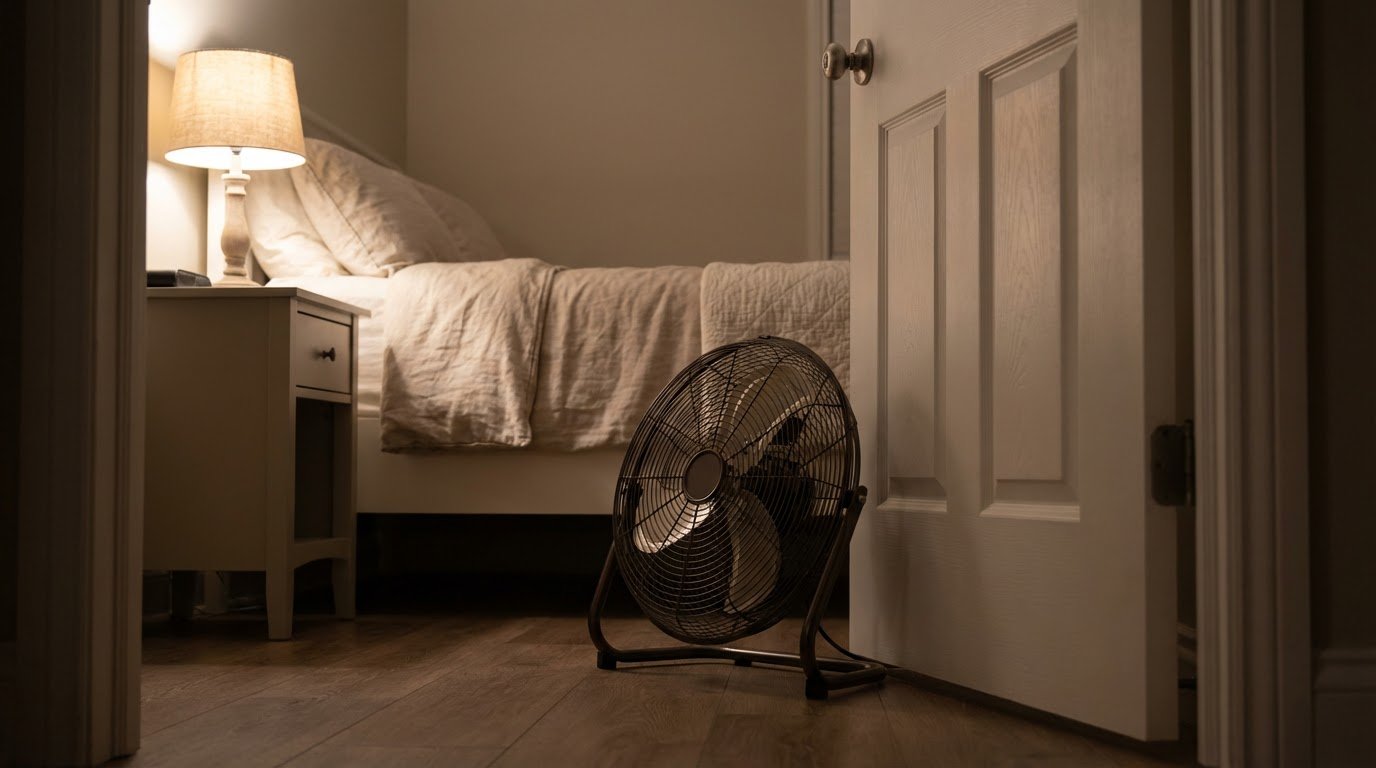
lf you get a stuffy bedroom at night, the fastest way to figure it out is to test airflow/return-air first, then check humidity clues and irritants.
Start with the 30-Second Result Card, then run the 10-Minute Bedroom Airflow Diagnosis below. You’ll know what’s most likely—and what to do tonight—without guessing.
- Door-crack test to confirm a return-air problem in under 60 seconds
- Tissue-strip airflow checks to spot “dead zones” without tools
- 48-hour “one-change” trial to avoid doing everything at once
Scope guardrails (what this covers)
One scenario only: your bedroom feels stuffy at night when the door is closed (heavy air, warm, harder to breathe, or you wake up feeling unrefreshed). This guide helps you quickly separate the most common causes: return-air blockage (airflow), humidity/heat load, or irritants. You’ll do short checks and pick one fix path you can actually execute.
Not covered (use a different guide / escalate)
- CO alarm, gas odor, sudden dizziness → leave and call emergency/utility
- Severe breathing distress, chest pain, fainting → urgent medical care
- Active water leak, soaked carpet, visible mold growth → moisture investigation and remediation
30-Second Result Card (pick your likely bucket)
Use this when you have a stuffy bedroom at night and want the fastest likely cause.
A) Return-air / airflow problem
Bedroom has a supply vent but no return vent, and it feels instantly better when you crack the door open 1–2 inches.
B) Humidity or heat load
You feel clammy, bedding feels warm and “damp-ish,” or the room feels heavier after showers, rainy weather, or AC cycles.
C) Irritants
You notice throat/eye irritation, fragrance or “cleaner” smell, or symptoms spike after cooking, sprays, candles, dusting, or pets on fabrics.
Start with these 3 steps now
- Do the door-crack test (60 seconds)
- Do the tissue-strip airflow check at the vent and under the door (3 minutes)
- Run a 20-minute targeted airflow reset (fan placement matters)
Escalate if
- symptoms worsen or sensitive occupants react (asthma, severe allergy, immunocompromised)
- you suspect CO/gas, or you have unexplained dizziness
- there’s persistent dampness you can’t locate
10-Minute Bedroom Airflow Diagnosis (no special tools)
Minimum tool kit
Flashlight
A single tissue strip (or a thin paper towel strip)
Optional: small hygrometer (nice-to-have)
Step 1: Door-crack test (60 seconds)
Close the bedroom door. Stand in the room for 30 seconds. Then crack the door open 1–2 inches.
If you feel immediate relief (air feels lighter, temperature drops, your breathing feels easier), you likely have a return-air pathway issue.
Step 2: Under-door airflow check (2 minutes)
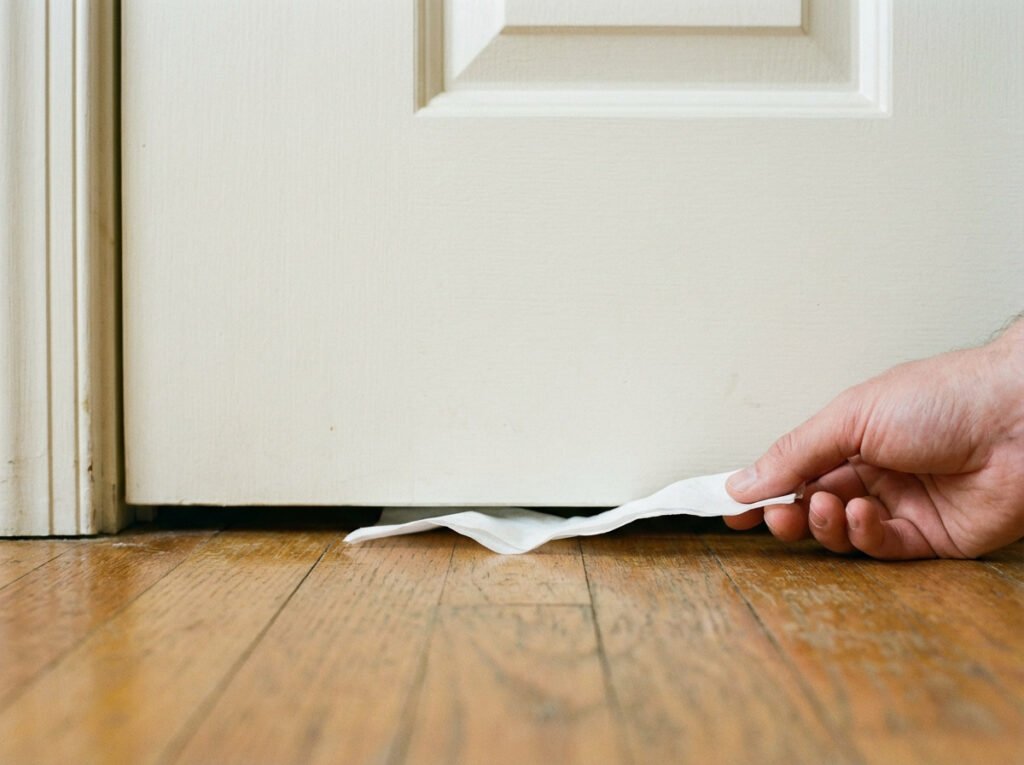
Hold a tissue strip near the bottom gap under the door.
- Tissue pulls into the bedroom strongly when HVAC is running → room may be starved for return air (pressure imbalance)
- Tissue barely moves and the room still feels stuffy → look at humidity/heat or irritants too
- Strong airflow but still stuffy with door closed → return path problem is likely
- Weak airflow → supply issue, blocked vent, closed damper, dirty filter, or HVAC distribution issue
Step 3: Return-path reality check (2 minutes)
Many bedrooms don’t have one.If there’s no return in the room, closing the door can trap air and reduce circulation. That alone can create “thick” air at night.
Step 4: Humidity clue check (3 minutes)
you have a hygrometer, take one quick reading in the bedroom (door closed) and one in the hallway.
Targets: aim for 30–50% RH when possible; keep under 60%.
If bedroom RH runs higher than the hallway, moisture and airflow are combining to create a heavy feeling.
What usually causes a stuffy bedroom at night (and how to verify it)
Cause 1: Return-air blockage (most common with closed doors)
Mechanism: the HVAC can push air into the room (supply), but with the door closed there’s no easy way for air to leave (return). Air exchange drops, temperature and humidity stratify, and the room feels heavy.
Verify: door-crack test improves comfort fast; supply airflow exists; no bedroom return vent.
Cause 2: “Dead zone” airflow (cold/hot pockets, poor mixing)
Mechanism: air is technically moving, but not where you sleep. Corners, thick curtains, and furniture placement can create stagnant zones.
Verify: stuffiness is worse on one side of the bed; tissue shows airflow at vent but the sleeping zone feels stale.
Cause 3: Humidity/heat load concentrated in the bedroom
Mechanism: respiration, warm bedding, and closed-door isolation can raise perceived humidity and heat. If the home is already humid, the bedroom becomes the worst pocket.
Verify: clammy feel; bedroom RH higher than hallway; worse after showers/rain.
Cause 4: Irritants trapped overnight
Mechanism: fragrances, cooking residues, dusty fabrics, and pet dander can concentrate when the door stays closed for hours.
Verify: throat/eye irritation; smell spikes; symptoms track with triggers (sprays/candles/pets on bed).
Fix options (prioritized, with conditions and trade-offs)
Option A: Create a return-air path without sleeping with the door wide open
Use when: door-crack test is positive and the room has supply but no return.
Ways to do it (choose one)
- Keep door slightly ajar (simple, immediate)
- Add a door undercut (more permanent; may affect noise/light)
- Install a transfer grille or jump duct (more effective; requires install)
Pros: fixes the core airflow problem
Cons: may require modification; privacy/noise trade-offs
Cost: Low to High
Time: same night to 1–2 weeks
Risk: Low
Option B: 20-minute targeted airflow reset (fast, no install)
Use when: you need relief tonight or you’re testing whether airflow is the driver.
How to do it
- Place a fan in the bedroom aimed toward the door (not at your face).
- Crack the door 1–2 inches and run the fan 20 minutes before bed.
This helps move stale warm air out and pull fresher air in.
Pros: immediate, cheap, good diagnostic value
Cons: doesn’t replace a proper return path if the door must stay fully closed
Cost: Low
Time: 20 minutes
Risk: Low
Option C: Reduce bedroom humidity load (only if humidity clues are present)
Use when: you feel clammy or bedroom RH runs high vs hallway.
Do this
- Run bathroom fan during showers and 20 minutes after
- Avoid drying laundry indoors for 48 hours
- Keep closet doors slightly open during the day for airflow
Pros: reduces heavy/clammy feel and musty tendency
Cons: may require routine in humid seasons
Cost: Low–Med
Time: 24–48 hours
Risk: Low
Option D: Irritant pause (48 hours) to isolate triggers
Use when: irritation symptoms dominate or you notice fragrance/chemical cues.
Do this
- Pause candles/incense and air fresheners
- Avoid strong sprays; use mild soap + water for surfaces
- Keep pets off bedding for 48 hours as a test (if applicable)
Pros: often reduces symptoms quickly
Cons: requires behavior changes
Cost: Low
Time: same day to 48 hours
Risk: Low
Option E: HVAC basics that often fix “weak airflow” bedrooms
Use when: tissue shows weak supply airflow.
Do this
- Make sure the bedroom vent is fully open and not blocked by furniture/curtains
- Check whether the HVAC filter is overdue and replace if needed
Pros: improves airflow house-wide
Cons: doesn’t fix return-path issues by itself
Cost: Low
Time: 15–30 minutes
Risk: Low
Targets and escalation points (so you know if it’s working)
Humidity targets
- Aim for 30–50% RH when possible
- Keep under 60% as a practical upper limit
- If RH is consistently very low and you wake with a very dry throat, consider whether over-drying is part of the problem
Time checkpoints
- 48 hours: you should see a clear improvement if airflow or irritants are the driver
- 7 days: if no improvement, escalate to HVAC distribution review, return-path solution, or IAQ evaluation
- 30 days: lock in a maintenance routine so the problem doesn’t rebound
7-Day Log (checklist format)
Use this 7-day log to spot patterns in 2–3 days. Copy it into Notes.
Date/Time: ________
Door overnight: closed / cracked / open
Worst feeling (circle): heavy air / hot / clammy / irritated throat/eyes
Comfort score (circle): 1 2 3 4 5
Today’s checks (check all that apply)
- Door-crack test improved comfort fast
- Tissue moved strongly under the door while HVAC ran
- Supply airflow felt weak at the vent
- Bedroom felt more humid than hallway (if you measured)
- Trigger in last 6 hours: cooking / sprays / candles / dust / pets / none
Actions today (check all that apply)
- 20-minute fan airflow reset before bed
- Bathroom fan used during/after shower (20 min after)
- Fragrance/candles paused
- Bedroom vent fully open and unobstructed
- HVAC filter checked/replaced if overdue
30-Day “Keep It Comfortable” Maintenance
Weekly
- Quick vent check: make sure supply vent is open and not blocked
- Do a 5-minute bedding/fabric odor check (especially if pets sleep in the room)
Monthly
- Replace/check HVAC filter on schedule (more often if you have pets or heavy dust)
- Re-test the door-crack check once to confirm airflow hasn’t drifted
Seasonal
- Humid season: tighten shower/laundry moisture control routines
- Cool season: watch for over-drying (dry throat canmimic “stuffy” discomfort)
Red Lines: Don’t DIY
- CO alarm, dizziness, gas odor → leave and call emergency/utility
- Severe breathing distress or chest pain → urgent medical care
- Repeated dampness you can’t locate or visible mold growth → professional evaluation and remediation
FAQ
- Why is my bedroom stuffy only when the door is closed?
Because airflow drops when the room can’t “return” air back to the HVAC pathway. Supply without return often feels stale overnight. - What’s the fastest confirmation test?
The door-crack test. If you feel better quickly with a 1–2 inch crack, airflow/return is likely the main issue. - Should I run a fan all night?
You can, but first test a 20-minute airflow reset before bed. If it helps, consider a more permanent return-air solution. - Is this always a humidity problem?
Not always. Humidity can worsen the “heavy air” feeling, but many stuffy bedrooms are primarily airflow/return-path issues. - When should I call a pro?
If you can’t create a workable return-air path, if supply airflow is consistently weak, or if symptoms persist beyond a week despite targeted fixes. - Is a stuffy bedroom at night usually an airflow problem? Yes—most often it’s an airflow/ventilation issue, with heat or humidity making it feel even stuffier at night.
Author Trust Block
Written by: WellZenx Editorial Team
Reviewed by: Home Environment Standards Editor (WellZenx)
Editorial standards: This article follows our Editorial Policy and fact-checking process.
Why trust this: We base recommendations on widely accepted guidance from sources such as the EPA/CDC and building-science best practices, and we prioritize measurable steps (RH readings, visible moisture clues, dry-out timelines).
Medical disclaimer: This content is for general education and does not replace medical advice.
Last updated: February 18, 2026
Related pages: Editorial Policy • Corrections • Medical Disclaimer • About WellZenx
Authority sources (external references)
EPA – A Brief Guide to Mold, Moisture, and Your Home
EPA – Mold resources
CDC – Carbon Monoxide (CO)
OSHA – Indoor Air Quality
ASHRAE – Indoor Environmental Quality resources