
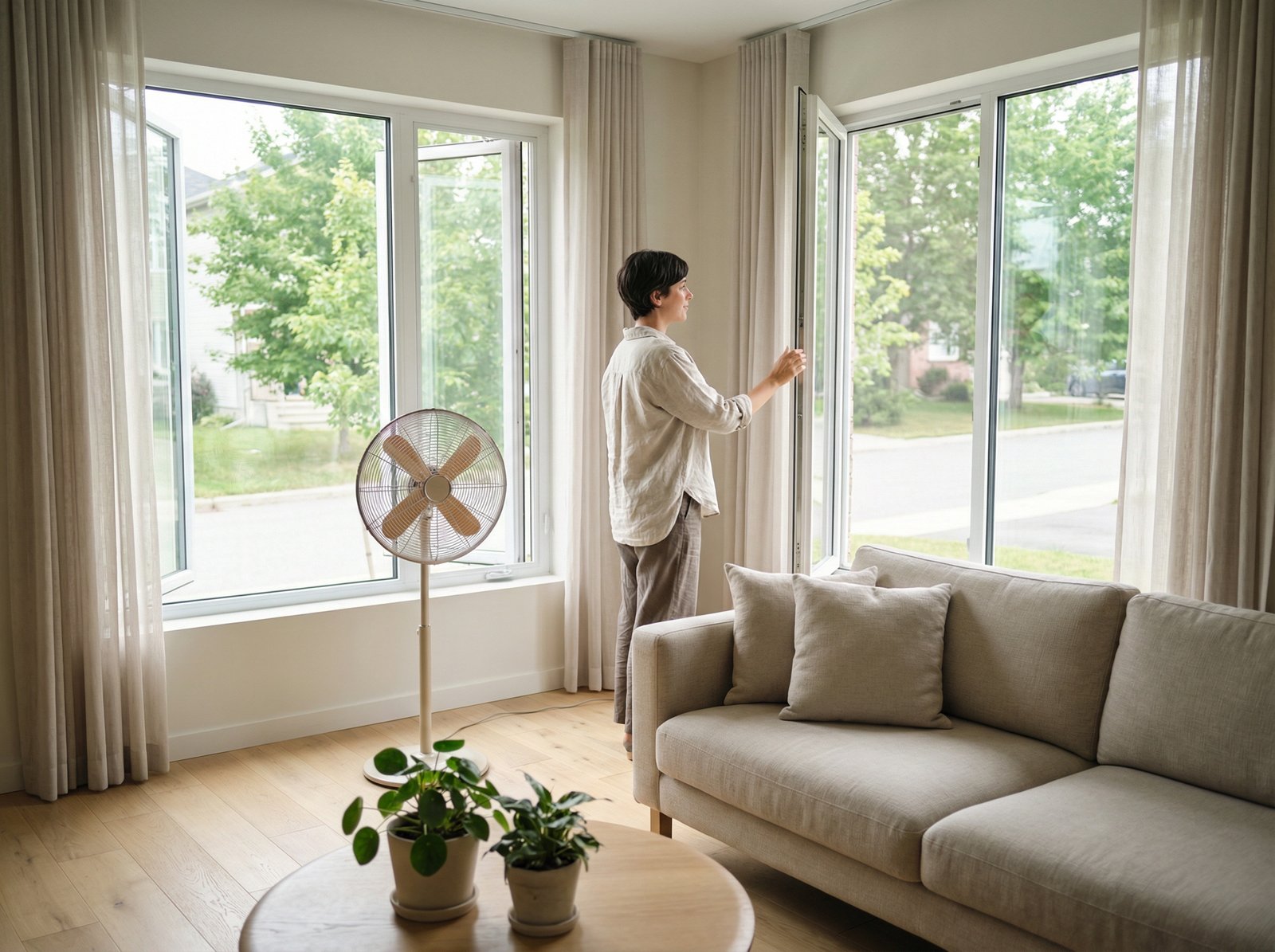
A quick airflow checklist to make a room feel fresh again.
Opening the windows is usually the first move when a room feels stuffy. The frustrating part is when you do that—and the air still feels heavy, stale, or hard to breathe.If the whole house feels stuffy even with windows open, check the broader airflow and pressurel issues here.
The good news: “stuffy” is rarely mysterious. It’s usually a simple airflow problem (air isn’t moving the way you think), or an indoor source (humidity, odors, dust, or chemicals) making the room feel “thick.” To fix a stuffy room fast, treat it like a mini airflow audit: move air out, pull fresh air in, and remove what’s making the air feel heavy air feel heavy.
Quick answer (30 seconds)
If your room feels stuffy even with windows open, do these three steps first:
- Create a real cross-breeze: Open two openings on different sides (another window, a door, a hallway window).
- Use a fan the right way: Put a fan near one window facing outward to push stale air out. If you have a second fan, place it on the opposite side facing inward.
- Run exhaust fans: Turn on the bathroom fan and range hood for 10–20 minutes (even if you’re not cooking/showering).
If the problem mainly shows up overnight, this stuffy bedroom at night guide is the better next step.

The 5-minute stuffy room checklist
Think of this like “debugging” your room.
1. Check for a cross-breeze (not just “a window open”)
- Best: two windows on opposite sides of the home, or window + open door to a hallway with another opening.
- Not enough: one window open in a closed room. That often creates a tiny exchange, not real ventilation.
Fast test: Stand near the doorway and feel the air. If the door area feels still, you probably don’t have a path for air to move through.
2.Fix fan placement (this is where most people lose speed)
A common mistake is pointing a fan into the room from a window. That can stir air around without removing the “stale” layer.
Try this instead:
- Place one fan 1–3 feet (30–90 cm) from a window, facing outward.
- If you have a second fan, place it at another opening facing inward.
- Keep interior doors open so air can actually travel.
3.Turn on exhaust where air naturally gets trapped
Even a “stuffy living room” can be affected by nearby spaces:
- Bathroom fan on (10–20 min)
- Range hood on (10–20 min)
- Laundry room door open (if there’s damp air)
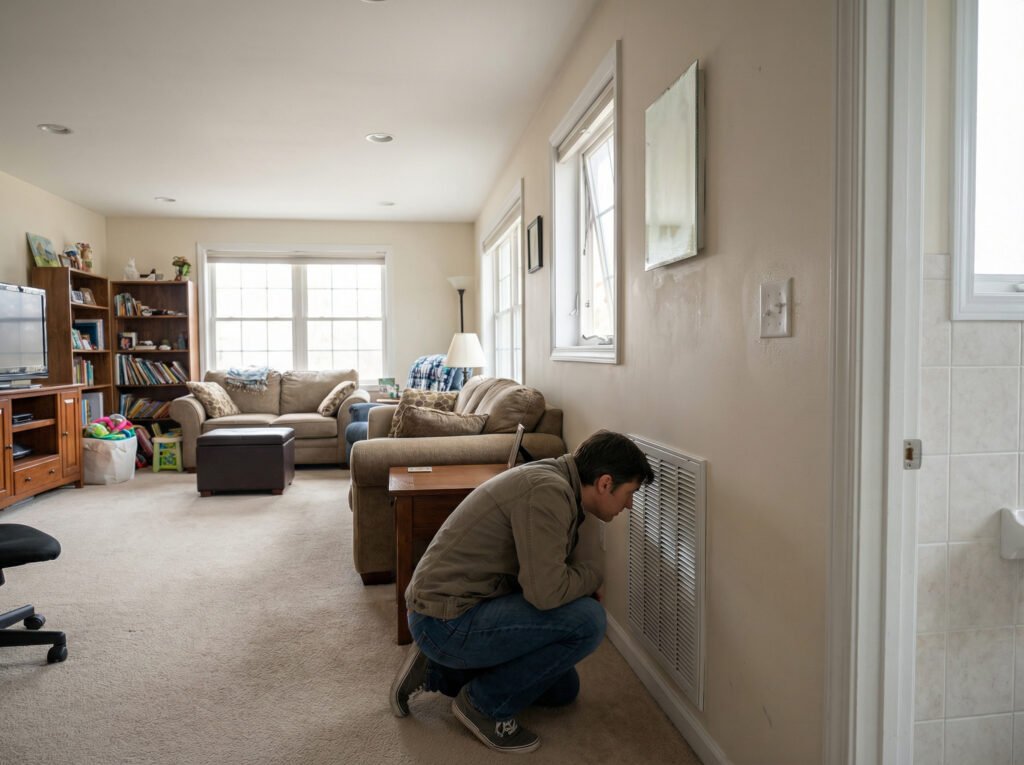
4.Look for blocked returns/vents
If you use HVAC, a blocked return can make a room feel stagnant:
- Is a return vent covered by a couch, rug, or heavy curtain?
- Is a supply vent closed or buried behind furniture?
5.Do a “source check” in 60 seconds
Stuffy often equals “something in the room is making the air feel heavy.”
- Damp towels, wet shoes, or a musty closet
- Trash, food odors, pet odor
- Recent cleaning chemicals, paint, or strong fragrances
- Dusty textiles: thick curtains, older rugs, clutter piles
If poor bedroom air shows up as a stuffy nose in the morning, use this bedroom-focused checkup.
What “stuffy air” actually means (in normal language)
People describe air as “stuffy” when one (or several) of these are happening:
- CO₂ buildup: In a closed room with people breathing, CO₂ rises and the air can feel “flat” or tiring.
- High humidity: Air feels heavy, sticky, and sometimes smells musty.
- Low airflow: No movement = you feel every odor and heat pocket more strongly.
- VOCs/odors: Scented products, cleaning sprays, new furniture, or cooking smells can make air feel “thick.”
- Dust/particles: Especially if you’re sensitive, dust buildup can make breathing feel uncomfortable.
That’s why the fix is a mix of air movement + removing sources, not “open one window and hope.”
10 common causes (and quick checks)
1. Only one window open
Clue: Air feels the same after 10 minutes.
Fix: Create a second opening and use the fan-out method.
2. The fan is pointed the wrong way
Clue: You feel air blowing, but the room still feels stale.
Fix: Put the fan near a window blowing out.
3. Door closed = no airflow path
Clue: The room feels stuffy, hallway feels fine.
Fix: Open the door; crack another window elsewhere.
4. Humidity is quietly high
Clue: Slight damp smell, condensation on windows, fabrics feel “heavy.”
Fix: Air out damp items; improve bathroom/kitchen exhaust; check for moisture sources.
(Why windows alone don’t solve stuffing air)
5. Bathroom fan/range hood isn’t actually venting well
Clue: Smells linger; bathroom feels damp long after shower.
Fix: Run longer; check if the fan is weak; keep door cracked for makeup air.
6. Cooking odors and fine particles
Clue: Room feels “thick” after cooking, even with windows open.
Fix: Use range hood + fan-out window purge for 10–15 minutes.
7. Dust traps (rugs, curtains, clutter corners)
Clue: Air feels worse when you disturb fabrics or walk around.
Fix: Quick vacuum, shake out textiles, reduce clutter zones.
8. Strong fragrances/cleaners
Clue: Stuffy started after cleaning or adding a new scent product.
Fix: Remove the source; ventilate hard for 20 minutes.
9. HVAC airflow imbalance
Clue: One room always worse than others.
Fix: Ensure vents open; don’t block returns; consider a simple airflow re-balance room-to-room.
10. A hidden damp spot
Clue: Stuffy + musty in the same corner/closet.
Fix: Inspect under sinks, behind furniture near exterior walls, and closets with stored fabrics.
Fixes that work (low-cost, practical)
Immediate (0–15 minutes)
- Fan near a window blowing out + second opening elsewhere
- Turn on bathroom fan + range hood
- Open interior doors to create an airflow path
- Remove obvious sources (damp towels, trash, strong fragrance items)
Today (15–60 minutes)
- Vacuum dust traps and textiles
- Check and unblock return vents
- Do a room-to-room “air swap” (move air from cleanest room toward the stuffy room, then out a window)
This week (if it keeps happening)
- Improve consistent ventilation habits (morning air-out routine)
- Identify repeating triggers (cooking days, laundry days, rainy days)
- Why Does My House Feel Stuffy Even With Windows Open?
- How to Improve Indoor Air Quality Without Expensive Equipment?
When a “stuffy room” is a warning sign
Most stuffy-room problems are normal and fixable. But don’t ignore these:
- A gas smell, burning smell, or chemical smell you can’t identify
- CO alarm going off (if you have one)
- Visible mold growth spreading quickly
- Breathing feels significantly difficult or you feel dizzy—leave the room and get help
This site provides general home-environment guidance, not medical advice.
FAQ
What makes a room stuffy?
Usually low airflow plus something that adds “heaviness” (humidity, odors, dust, or VOCs).
Why is my room stuffy even with windows open?
Because a single open window often doesn’t create a path for air to move. You need cross-ventilation and correct fan placement.
How do I make a room not stuffy fast?
Open a second window/door, place a fan near one window blowing out, run exhaust fans, and remove obvious odor/humidity sources.