
By: WellZenx Editorial Team
Published: January 22, 2026 (ET)
Updated: January 22, 2026 (ET)
Scope guardrails (what this covers)
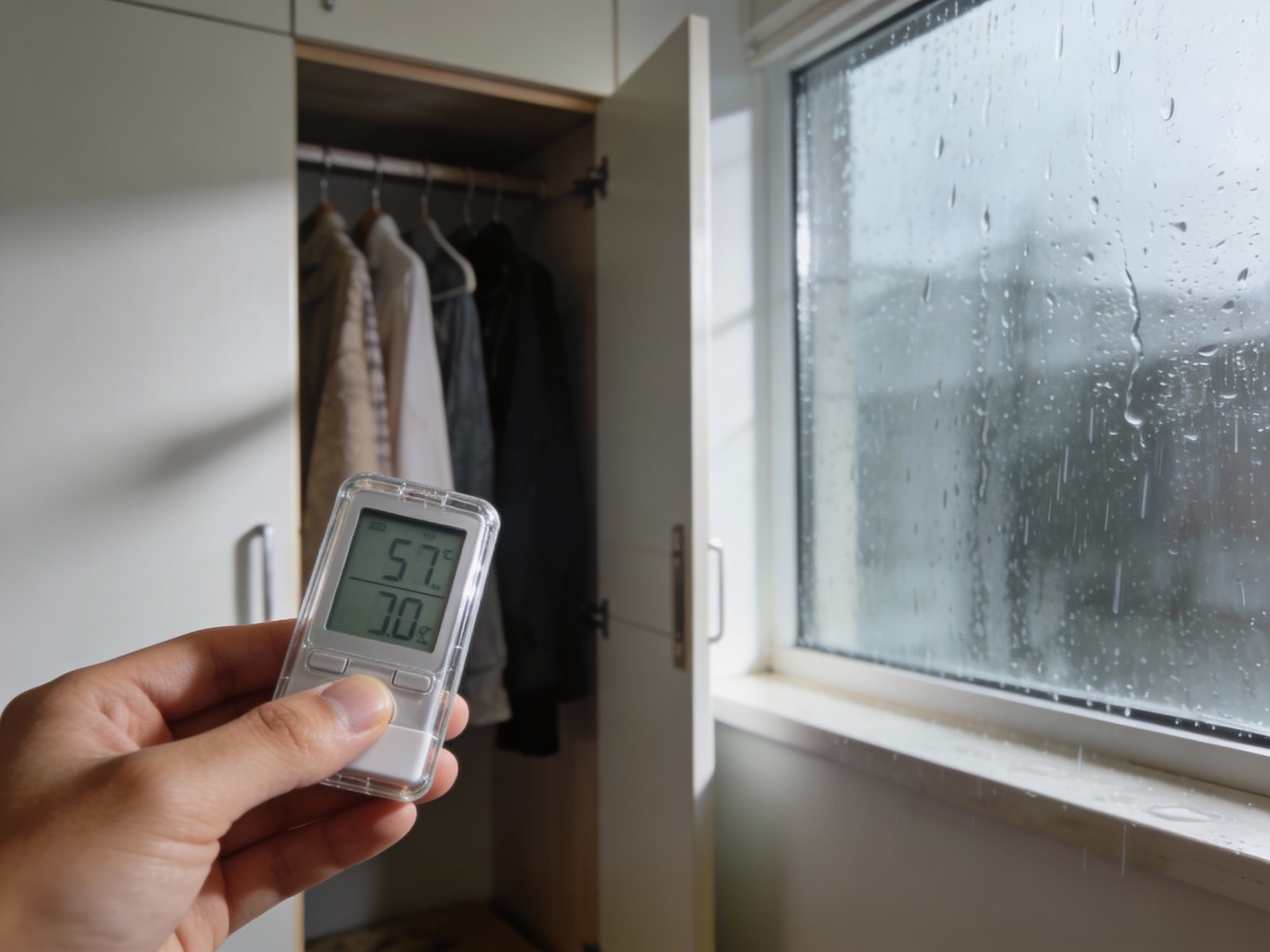
This guide is for one specific scenario: your bedroom closet smells musty within hours of rain, and you want a simple way to identify the moisture driver, dry it fast, and keep it from coming back.
Out of scope (don’t use this guide for these)
- Floodwater, sewage backup, or contaminated water exposure
- A ceiling that is actively dripping or collapsing
- Strong “rotten egg” gas odor, dizziness, or electrical burning smells (treat as safety emergencies)
30-Second Answer Card
You’ll usually fall into one of these types
- Type A — Indoor humidity spike: Rainy weather pushes indoor RH up, and the closet (low airflow) shows it first.
- Type B — Localized rain intrusion: Water is entering near a window/roof/exterior wall and wetting a hidden spot.
- Type C — Closet “odor reservoir”: Clothes, shoes, cardboard, or carpet edges absorb moisture and re-emit musty odor after rain.
Do these 3 steps first (10 minutes total)
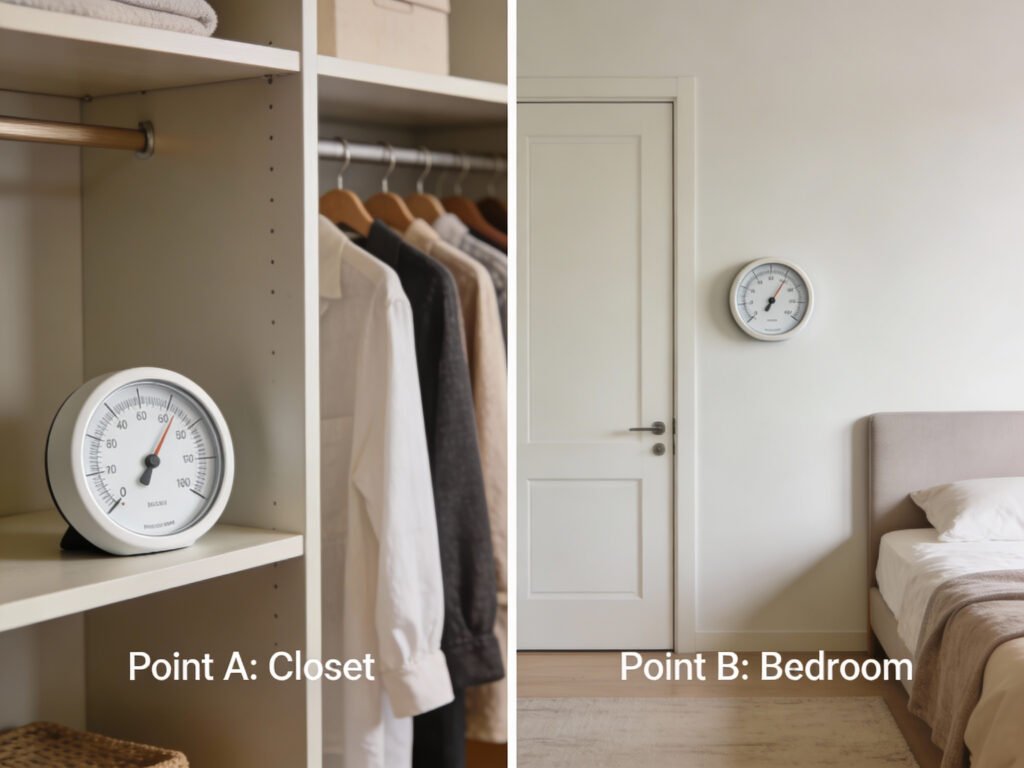
- Measure RH in two places: inside the closet and in the bedroom (same height).
Target: 30–50% RH. Red flag: 60%+ that lasts. - Find one “wet clue”: flashlight scan + paper towel swipe on baseboards/corners/closet floor edge.
Goal: identify one suspect spot (even a small one). - Start a 48-hour dry-out: airflow + moisture removal + remove damp reservoirs.
Rule: the faster you dry (within 24–48 hours), the less likely mold takes hold.
When to escalate
- 48 hours: RH won’t drop under 60% or odor is unchanged → stop “just drying” and trace the entry path.
- 7 days: odor returns after every rain → plan a focused inspection (window/roof/gutters/exterior wall).
- 30 days: recurring dampness, visible growth, or high-risk occupants → consider professional moisture/mold evaluation.
10-Minute Diagnosis (simple tools, clear outcome)
Minimum tool kit
- Hygrometer/thermometer
- Flashlight
- Paper towels
- Disposable gloves
- Painter’s tape (to mark suspect spots)
Optional: a basic moisture meter (helpful, not required)
10-minute self-check (most common → highest risk)
- Confirm it’s really the closet (1 minute)
Close the closet door for 20–30 minutes, then open it. If the musty smell “puffs out,” the closet is the source zone. - Two-point RH check (2 minutes)
Measure RH and temperature:
- Point A: inside the closet, mid-shelf height (not on the floor)
- Point B: in the bedroom near the closet door, same height
Write both numbers down.
- Look for the closet’s “cold wall” (2 minutes)
Find the wall that faces outdoors. Closets on exterior walls often get colder and see condensation first. - Flashlight scan + touch test (3 minutes)
Check: back corners, baseboards, the floor edge (especially where carpet meets wall), and the bottom of hanging clothes.
Touch for coolness and any tacky/damp feel. - Paper towel swipe test (2 minutes)
Wipe the baseboard edge and the corner seam where walls meet.
If the towel comes back damp or streaked, mark that exact spot with tape and a date.
Diagnosis output (pick one)
- If RH is high in both closet and bedroom: likely Type A (humidity spike), with the closet amplifying it.
- If RH is normal but one corner/baseboard swipes damp or shows staining: likely Type B (localized intrusion).
- If RH is normal but odor is strongest on items (shoes, hamper, cardboard, carpet edge): likely Type C (odor reservoir).
Root Causes (with proof clues you can verify)
Cause 1: Rain pushes indoor humidity up, and the closet traps it (Type A)
Why it happens: Rainy air is moisture-heavy. The closet has low airflow, packed fabrics, and sometimes cooler exterior surfaces. That combination makes odors stronger.
Proof clues: RH is elevated in the whole bedroom, not just the closet. Odor improves when the closet is left open with airflow.
Verify fast: If Point A and Point B are both high, treat it as a humidity-driven problem first.
Cause 2: Condensation on a cool exterior wall behind clothes (Type A/C)
Why it happens: A closet on an exterior wall can be cooler than the room. When warm humid air hits that cool surface, moisture can form in corners and behind hanging clothes.
Proof clues: Odor is strongest at the back wall, especially behind tightly packed clothing. The wall feels cooler to the touch.
Verify fast: Pull clothes 3–6 inches off the back wall for a day and re-check odor and RH.
Cause 3: Small window/roof/gutter intrusion wets the wall cavity (Type B)
Why it happens: Wind-driven rain finds weak points—window corners, flashing, roof penetrations, clogged gutters. Moisture can travel inside the wall and show up as a closet smell.
Proof clues: A specific stain line, bubbling paint, soft drywall, or dampness that repeats after rain in the same spot.
Verify fast: Mark the suspect spot, then check it again after the next rain. Recurrence in the same location is a big clue.
Cause 4: Closet “reservoirs” that re-emit odor after rain (Type C)
Why it happens: Shoes, cardboard, baskets, carpet pad edges, and even dust can hold moisture and release musty odor when humidity rises.
Proof clues: Odor is strongest on items, not the wall. A single box or shoe shelf smells worse than the rest.
Verify fast: Bag-and-isolate test. Seal one suspect item in a trash bag for 12 hours. If the bag smells musty inside, that item is part of the problem.
Fix Options (ranked, with tradeoffs)
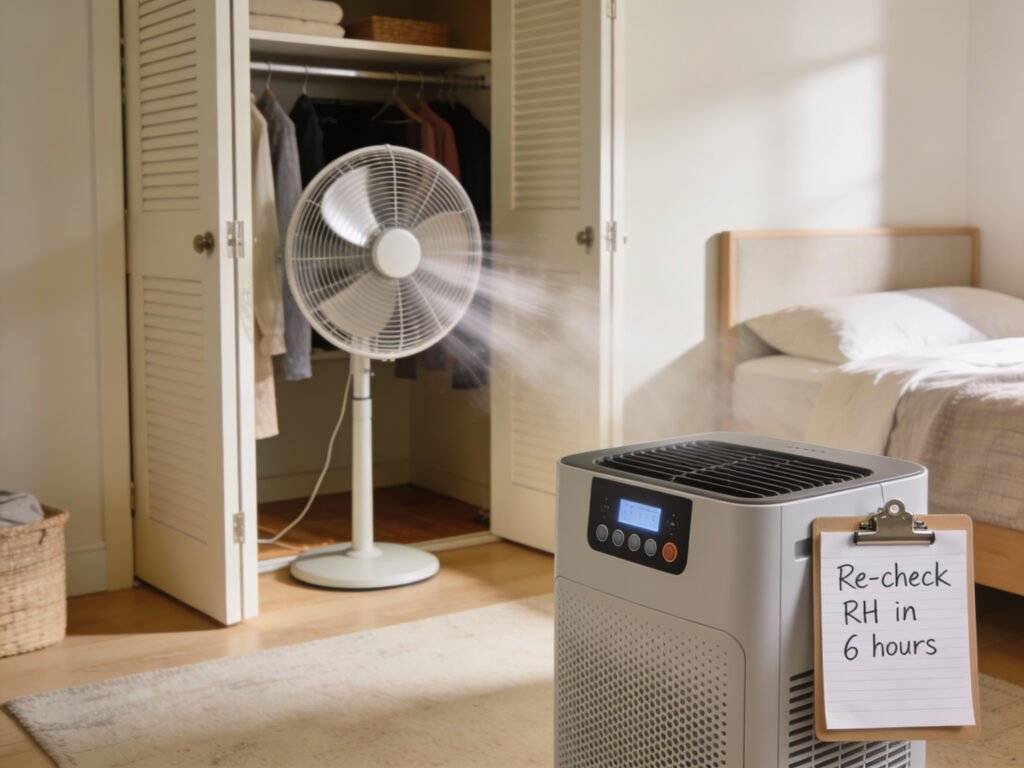
Option 1: 48-hour closet dry-out reset (fastest relief)
When to use: Any type, especially when you need quick improvement and clearer clues.
Steps:
- Remove reservoirs: take out damp shoes, cardboard, laundry hampers, and anything that smells musty.
- Create airflow: keep the closet door open. Aim a fan so it moves air across the closet opening (not blasting directly into clothes).
- Remove moisture: run AC or a dehumidifier in the bedroom. Keep interior doors open to circulate air.
- Re-measure RH 2–3 times/day and log it.
Pros: Fast relief; reveals whether a leak is ongoing.
Cons: If a hidden leak continues, odor returns.
Cost level: Low–Med
Time: 2 days
Risk: Low (avoid running electrical devices on wet floors)
Good for: Mild musty odor after rain; early-stage dampness; confirming Type A vs B vs C.
Not for: Active leaks, sewage exposure, widespread visible mold.
Option 2: Closet airflow + spacing upgrade (best “no-tools” prevention)
When to use: Closet is packed, on an exterior wall, or odor improves when door stays open.
Steps:
- Pull hanging clothes 3–6 inches off exterior walls.
- Don’t store cardboard on the closet floor. Use plastic bins with lids and keep them off the floor.
- Add a small passive airflow rule: leave the closet cracked open for 30–60 minutes after showers/cooking on rainy days.
Pros: Low cost; reduces condensation risk.
Cons: Doesn’t fix a real intrusion leak.
Cost level: Low
Time: 30–90 minutes setup
Risk: Low
Good for: Type A/C patterns; seasonal musty odor.
Not for: A confirmed damp wall spot that repeats after rain.
Option 3: Humidity control target (Type A)
When to use: Your RH stays elevated after rain across the bedroom/house.
Steps:
- Aim for 30–50% RH if possible, and try to keep it under 60%.
- Limit window opening during/after rain.
- Run bathroom exhaust during showers and for 20 minutes after.
- Use AC “dry” mode if available; consider a dehumidifier if rainy-season RH stays high.
Pros: Reduces triggers for musty odor and microbial growth conditions.
Cons: Ongoing energy use; may not solve Type B.
Cost level: Med
Time: 2–14 days to stabilize
Risk: Low
Good for: Whole-room humidity spikes after rain.
Not for: A localized damp spot that keeps re-wetting.
Option 4: Find and stop a localized intrusion (Type B)
When to use: One corner/baseboard/wall area repeats dampness after rain.
Steps:
- Follow the “same-spot-after-rain” rule: if the same location is damp after each rain, focus outside above that spot.
- Check gutters and downspouts first (overflow and splashback can soak walls).
- Inspect window corners and exterior caulk lines near the closet wall.
- If the closet is under a roof valley or near a chimney/vent, consider a roof inspection.
Pros: Fixes the true cause; prevents recurrence.
Cons: May require ladder work or a contractor.
Cost level: Med–High
Time: 1–14 days
Risk: Med (don’t DIY unsafe heights)
Good for: Repeated staining/dampness in one location.
Not for: Pure humidity spikes without a localized wet clue.
Option 5: Clean only after dry (odor residue removal)
When to use: Closet is dry but odor lingers on surfaces.
Steps:
- Wipe hard surfaces and baseboards after the area is dry.
- Wash fabrics that smell musty. Dry them fully before re-hanging.
Pros: Removes odor residue.
Cons: Cleaning doesn’t fix moisture.
Cost level: Low–Med
Time: 1–4 hours
Risk: Low
Good for: Post-dry-out lingering smell.
Not for: Damp drywall, wet carpet pad, or ongoing intrusion.
Thresholds used in this article
- Indoor RH target: 30–50% (ideal)
- Indoor RH upper limit: keep it under 60%
- Dry-out window: aim to dry wet areas within 24–48 hours
- Escalation: 48 hours no improvement → trace entry path; 7 days recurring → inspection; 30 days recurring → pro help
7-Day Improvement Plan (daily tasks + targets)
Day 1: Diagnose + start 48-hour dry-out
Target: RH trending down; closet odor drops at least one level (1–5 scale).
Fail: RH stays high and odor unchanged → move to Type A humidity control and check for a localized wet clue.
Day 2: Remove reservoirs + spacing rule
Target: No cardboard on floor; clothes pulled off exterior wall; shoes/hamper aired out.
Fail: One specific item still smells strong → isolate it or discard it.
Day 3: Repeat the wet-clue test
Target: Paper towel swipe comes back dry at yesterday’s taped spot.
Fail: Still damp in the same spot → treat as Type B and start intrusion checks.
Day 4: Closet “airflow habit”
Target: Closet gets 30–60 minutes of airflow during the dampest part of the day.
Fail: Odor returns when closet is closed → increase moisture removal (AC/dehumidifier) and re-check RH.
Day 5: Confirm with numbers
Target: RH under 60% consistently; trending toward 30–50%.
Fail: RH remains high → tighten humidity control (windows closed during rain, exhaust use, dehumidification).
Day 6: Surface cleanup after dry
Target: Closet is dry to the touch, then surfaces and fabrics are cleaned and fully dried.
Fail: Any surface feels damp → do not “clean over moisture.” Return to drying.
Day 7: Rain recurrence test
Target: After the next rain, closet odor does not return or is brief and mild.
Fail: Odor reliably returns after rain → schedule targeted inspection for gutters/windows/roof and consider a moisture meter or pro evaluation.
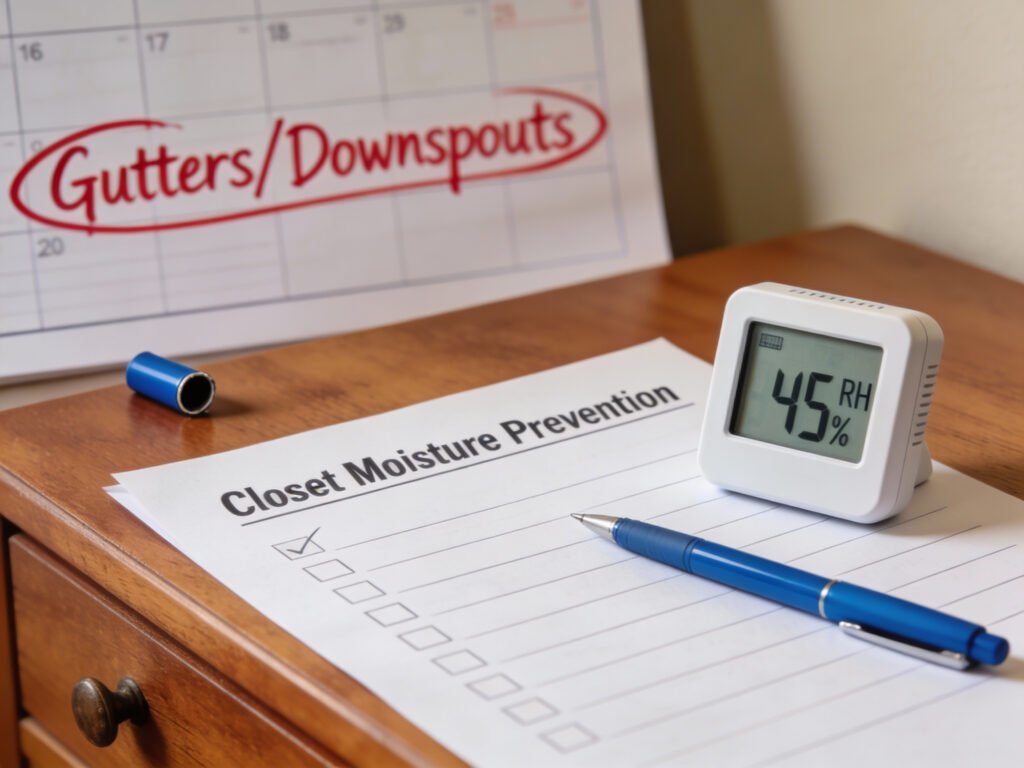
30-Day Relapse Prevention (weekly/monthly checklist)
Weekly
- Check RH in the closet and bedroom (same height).
- Quick corner scan with a flashlight (back wall corners and baseboard).
- Keep clothes off the exterior wall and avoid floor-level cardboard storage.
Monthly
- Inspect gutters/downspouts for overflow and splashback near the closet wall line.
- Check window corners (inside and out) for recurring stains or soft drywall.
- Do a “closet reset”: remove everything from the floor, wipe, and fully dry before restocking.
Seasonal
- Rainy season rule: limit window airing during/after rain; run exhaust fans longer.
- Winter rule (if applicable): watch for condensation on exterior walls and keep closet airflow higher.
Odor Quick-Check (closet-relevant smells only)
Musty/earthy
Check first: back wall corners, baseboard seams, carpet edge
Likely cause: damp surfaces or fabrics
Quick test: paper towel swipe + RH log
First actions: 48-hour dry-out + remove reservoirs
Sour laundry smell
Check first: hamper, towels, gym clothes
Likely cause: fabrics stored damp or not fully dried
Quick test: bag-and-isolate test on one item
First actions: wash and fully dry; don’t store damp items
Wet shoes/leather smell
Check first: shoe rack and floor area
Likely cause: shoes absorbing humidity and re-releasing odor
Quick test: isolate one pair in a bag overnight
First actions: air-dry shoes; use a breathable rack; keep off floor
“Sweet” damp drywall smell (localized)
Check first: one repeating corner or wall patch
Likely cause: hidden moisture in wall cavity
Quick test: mark spot; check after next rain
First actions: intrusion-path inspection (gutters/window/roof)
Copy/Paste Templates
Moisture & Odor Log (copy into Notes)
- Date/Time (ET or local):
- Weather (rain / after rain / humid):
- Closet RH% / Temp:
- Bedroom RH% / Temp:
- Odor level (1–5):
- Closet wall location (exterior wall? yes/no):
- Paper towel swipe result (dry/damp/streaked):
- Suspect items removed (yes/no + which):
- Actions (fan/AC/dehumidifier/door open):
- Result after 6 hours:
- Result after 24 hours:
- Result after 48 hours:
Closet Reservoir Triage Checklist
- Shoes (smell test each pair)
- Cardboard boxes (remove first)
- Laundry hamper (wash + dry)
- Carpet edge / rug (lift and check underside)
- Bags and fabric storage bins (air out and smell test)
Decision Tree (simple)
- Closet musty after rain → Measure RH in closet + bedroom
- If both high → Type A → humidity control + airflow + 48-hour dry-out
- If only one spot repeats dampness → Type B → trace intrusion path (gutters/window/roof)
- If numbers are normal but items smell → Type C → remove/replace reservoirs + keep airflow higher
Red Lines: Don’t DIY
- If there is widespread visible growth, repeated regrowth, or you can’t identify the moisture driver → stop guessing and get professional help.
- If anyone in the home is high-risk (asthma, severe allergies, immunocompromised, elderly, infants) → reduce exposure and get professional guidance.
- If you suspect gas/CO (rotten-egg odor, dizziness) → leave immediately and contact emergency services or your utility.
- If water is near outlets, panels, or wiring → shut off power to that area and call an electrician.
- If there is sewage backup or contaminated water → do not DIY cleanup.
FAQ
- Why does the closet smell musty only after rain?
Rain often raises indoor humidity. Closets trap moist air and odors, especially on exterior walls or when packed tight. - What humidity is “too high” for a closet?
If RH stays around 60%+ after rain, musty odor and moisture risk go up. Aim lower if you can. - Should I keep the closet door open all the time?
Not necessarily. Use airflow strategically during humid periods and fix the root cause if a damp spot repeats. - Can I use odor absorbers instead of drying?
Odor absorbers don’t remove moisture. Dry first. Then use absorbers as a supplement. - How do I know it’s a leak and not humidity?
A leak tends to create a repeating damp spot or stain in the same location after rain. Humidity is more “whole-room” and number-driven. - Do I need to throw away clothes that smell musty?
Often no. Wash and dry fully. But if an item stays musty after proper drying, it may be a reservoir. - What’s the fastest way to get relief?
Remove musty items, open the closet, move air across the opening, and run AC/dehumidification for 48 hours. - When should I call a professional?
If the odor returns after every rain, if you find recurring dampness in the same spot, or if you have high-risk occupants.
Sources & Notes (Authority consensus vs Practical tips)
Authority consensus (references)
- EPA guidance on keeping indoor RH below 60% (ideally 30–50%) and moisture control for mold prevention.
- EPA guidance that drying wet/damp materials within 24–48 hours often prevents mold growth.
- CDC guidance emphasizing rapid drying (within 24–48 hours when possible), especially after water exposure.
- OSHA guidance recommending cleaning and drying wet/damp spots as soon as possible (preferably within 24–48 hours).
- ASHRAE guidance commonly referencing humidity control (often ≤65% in occupied spaces) to reduce microbial growth conditions.
Practical tips (WellZenx workflow)
- Two-point RH check (closet vs bedroom) to separate whole-room humidity from localized intrusion.
- Paper towel swipe + tape marking to confirm whether a damp spot is recurring after rain.
- 7-day plan to force a clear decision: keep drying vs escalate to intrusion-path inspection.
Author Trust Block
Written by: WellZenx Editorial Team
Reviewed by: Home Environment Standards Editor (WellZenx)
Editorial standards: This article follows our Editorial Policy and fact-checking process.
Why trust this: We base recommendations on widely accepted guidance from sources such as the EPA/CDC and building-science best practices, and we prioritize measurable steps (RH readings, visible moisture clues, dry-out timelines).
Medical disclaimer: This content is for general education and does not replace medical advice.
Last updated: January 22, 2026
Related pages: Editorial Policy • Corrections • Medical Disclaimer • About WellZenx
Authority sources
EPA Mold Course (Humidity guidance: RH below 60%, ideally 30–50%).
EPA “A Brief Guide to Mold, Moisture, and Your Home” (dry within 24–48 hours).
CDC mold guidance / cleanup materials (24–48 hour drying emphasis).
OSHA mold prevention guidance (clean/dry wet or damp spots preferably within 24–48 hours).
ASHRAE humidity control guidance (often ≤65% in occupied spaces).