
Start here: do this first (before you sniff around)
A “sewer” smell near a toilet is often a plumbing seal issue—but don’t assume it’s harmless. Sewer gas can contain gases like hydrogen sulfide and methane.
60-second safety steps
- Open an exterior door or window on your way in (quick ventilation).
- Do not use flames to “test” the smell.
- If anyone has headache, dizziness, nausea, confusion, leave for fresh air and treat it as an urgent indoor-air event. (CO is odorless; symptoms matter more than smell.)
Applies: sudden strong odor, symptoms, older/child/pregnant/sensitive occupants
Not applicable: none—these are always safe first steps
If your home also feels sealed-up and uncomfortable, see house feels stuffy even with windows open (it helps explain pressure-driven odor pull).
RED LINE module (clear lines, clear actions)
Stop DIY and escalate if ANY of these are true:
- Strong “rotten egg” smell that’s rapidly worsening (especially in multiple rooms)
- Symptoms indoors: headache, dizziness, weakness, upset stomach, vomiting, chest pain, confusion
- You suspect carbon monoxide exposure (CO is odorless—you cannot smell it)
- You smell gas near fuel-burning equipment, or your CO alarm sounds
- Odor is strongest near a wall/utility chase and you can’t localize it (possible hidden venting/structural issue)
Red-line actions (action verbs, in order)
- Leave to fresh air if anyone is symptomatic.
- Call local emergency help or a qualified pro if symptoms persist or alarms sound.
- Do not re-enter and “keep testing” if symptoms worsen indoors.
Authority consensus: CO can’t be detected by smell, and symptoms require immediate fresh air and help.
WellZenx field note: If multiple people feel “flu-ish” indoors and better outside, stop chasing the odor—treat it as an exposure problem first.
What “toilet-base sewer smell” usually means
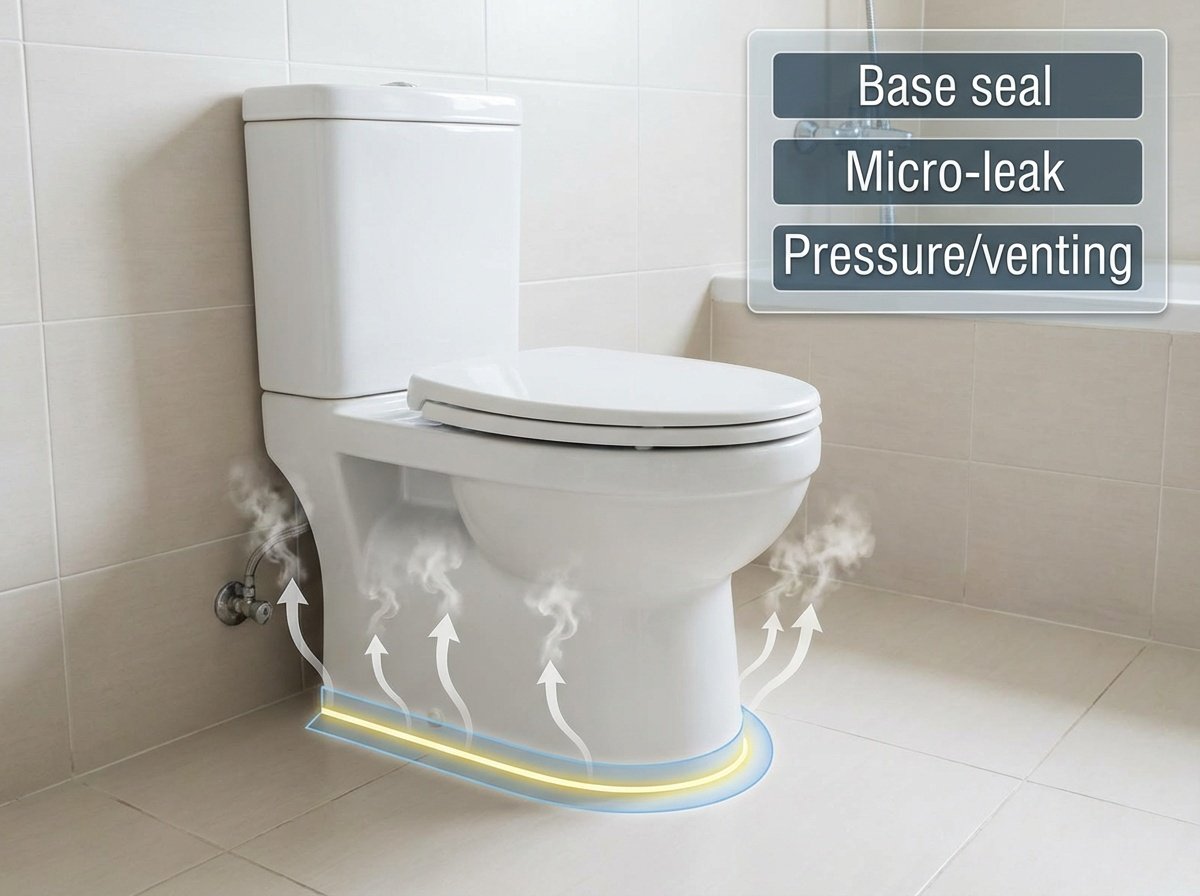
When the smell is strongest at the toilet base (not the sink drain, not the floor drain), the top causes are:
- A compromised base seal (often the wax ring or seal) letting sewer gas escape at the flange
- A micro-leak (dirty water or urine) wicking into grout/subfloor and re-odorizing
- Pressure/venting issues pulling odors out of plumbing paths when exhaust fans run (negative pressure can reverse airflow paths)
The goal is to identify which one you have—fast—without guessing.
10-minute pinpoint test: wax ring vs “dirty leak” vs venting
Test 1 (2 minutes): The “nose map”
- Smell low (near the base), then higher (tank height), then near the floor drain if you have one.
- If the odor is strongest at the base seam, that’s your #1 clue.
Applies: base seam odor
Not applicable: odor is clearly from drain opening (use drain article instead)
If the smell is stronger at a drain than at the toilet base, jump to bathroom floor drain smells.
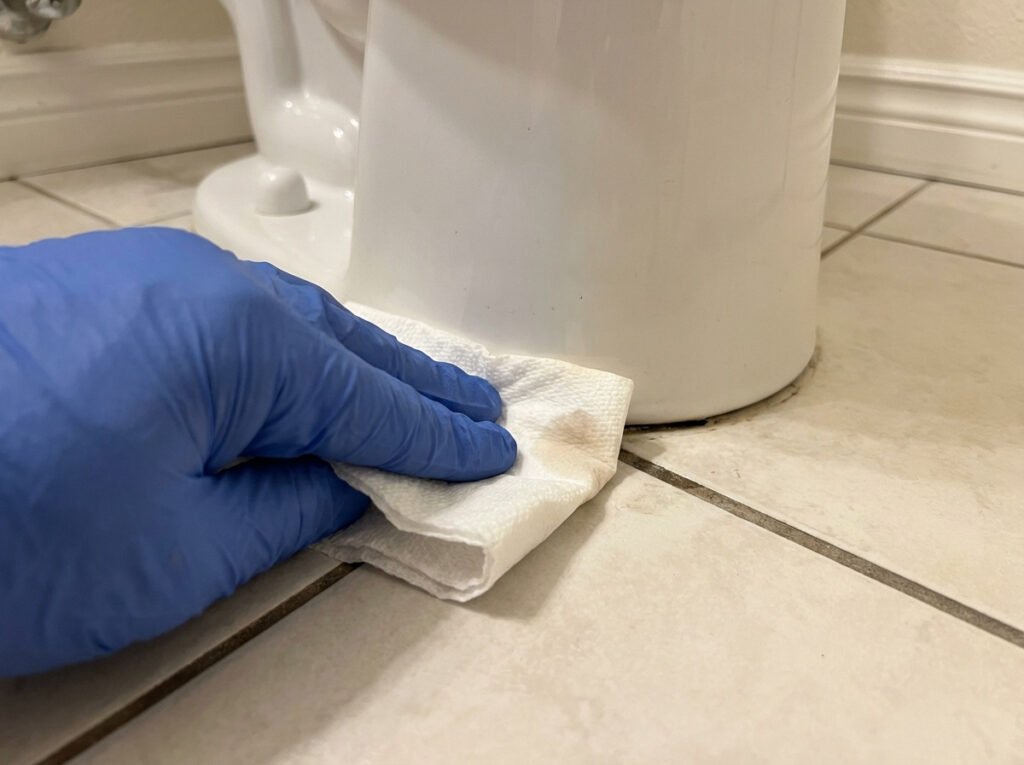
Test 2 (3 minutes): Paper towel wipe test (dirty-water vs gas)
You’re looking for moisture that confirms a leak path.
- Dry-wipe the floor around the base with a white paper towel.
- Press the towel into the grout line/edge seam.
- Smell the towel immediately (yes, it’s gross—but it’s decisive).
Interpretation
- Towel smells like sewage + is damp/dirty: likely a leak (seal failure or loose base)
- Towel is dry but area smells “gassy”: more likely a gas leak path (wax ring/venting)
Applies: you suspect a tiny leak you can’t see
Not applicable: standing water or active leak—stop and fix plumbing now
Test 3 (3 minutes): Fan/pressure trigger test (venting/negative pressure)
This separates “seal problem” from “pressure makes it worse.”
- Close the bathroom door.
- Turn on the bath fan (or range hood).
- Wait 60 seconds.
- Step back in and check odor intensity at the base.
If odor gets worse when exhaust runs, pressure is likely pulling air through leaks/paths (negative pressure can cause airflow reversal and backdrafting behaviors in buildings).
Applies: odor is intermittent or fan-triggered
Not applicable: symptoms/CO alarm (use Red Line actions)
For the fastest “why this happens,” see house feels stuffy even with windows open.
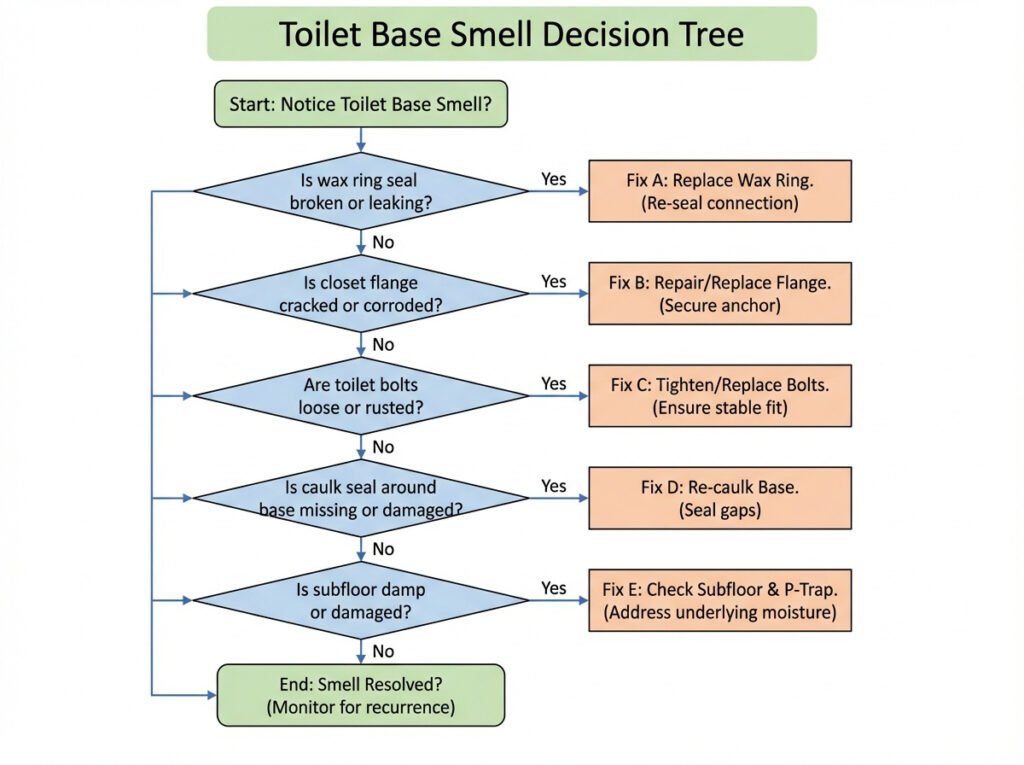
Decision Tree (Original Asset): “Toilet Base Smell” in 5 branches
Start: Sewer-like odor is strongest near the toilet base.
- Is there visible rocking when you sit/press the toilet (even slightly)?
- Yes → high chance the base seal is compromised. Go to Fix A.
- No → go to Step 2.
- Does odor get worse when the bath fan/range hood runs?
- Yes → pressure/venting involvement. Go to Fix C.
- No → go to Step 3.
- Paper towel comes back damp or dirty at the base seam?
- Yes → dirty leak path. Go to Fix B.
- No → go to Step 4.
- Odor is strongest at floor drain/sink drain, not the base?
- Yes → not a toilet-base issue. Go to Fix D (drains).
- No → go to Step 5.
- Odor persists but you can’t localize and it’s near a wall/chase?
- Yes → hidden venting/structural path. Go to Fix E (escalate).
WellZenx field note: A toilet that rocks—even “a little”—is the fastest predictor of repeat smell problems.

Fix A: If the toilet rocks (most common “wax ring fails again” story)
What to do (safe, practical)
- Stop using the toilet until it’s stabilized (rocking breaks seals).
- Tighten gently only if you know what you’re doing—over-tightening can crack the base.
- Best practice: reset the toilet (new seal) and shim/stabilize so it never rocks again.
Applies: any rocking; repeated odor returns after cleaning
Not applicable: you’re not comfortable lifting a toilet—hire a plumber (this is a “worth it” pro job)
Authority vs experience
- Authority consensus: sewer gas can include methane and hydrogen sulfide; repeated entry is not something to ignore.
- WellZenx practical: most “wax ring” failures are actually “toilet not stable + seal gets crushed again.”
Fix B: If the base seam is damp/dirty (micro-leak path)
This is a different problem than “gas only.” If waste water/urine is wicking into porous grout or subfloor, it can smell even after the surface looks clean.
What to do
- Dry the area completely (fan + towels).
- Record whether dampness returns after a few flushes.
- If it returns: stop and schedule repair (seal reset, flange evaluation).
- After repair, clean and seal the grout line if needed (only after leak is fixed).
Applies: damp towel, recurring odor after mopping
Not applicable: active leak, ceiling stain below, soft floor—treat as urgent water damage
If the bathroom also has a persistent damp/musty smell, see house smells musty but no visible mold.

Fix C: If exhaust fans make it worse (pressure/venting branch)
If the smell spikes when a bath fan or range hood runs, your home may be pulling air from the easiest openings, including plumbing pathways. Negative pressure can contribute to backdrafting and airflow reversal behaviors in buildings.
What to do tonight (low-risk steps)
- Crack a window 1–2 inches while running the bath fan.
- Pause competing exhaust (dryer + other fans) for the 10–20 minutes you need.
- If this consistently helps, you likely need a longer-term airflow plan.
Applies: odor is fan-triggered or worse when the house is closed up
Not applicable: suspected combustion/CO problems—use Red Line actions
For fast airflow steps, see how to fix a stuffy room fast.
Fix D: If it’s actually a drain smell (not the toilet base)
Many “toilet smells” are really dried trap seals or biofilm in nearby drains.
What to do:
- Use the trap-seal test and clean routine in bathroom floor drain smells.
- If the smell is strongest at a shower drain, see shower drain smells.
Applies: smell is strongest at drains, not at base seam
Not applicable: damp/dirty at base seam (Fix B instead)
Fix E: If it’s coming from a wall gap or chase (escalate)
When odor seems to come from behind the toilet, a wall cavity, or a plumbing chase—and you can’t localize it—treat it as higher risk. Sewer gas mixtures can include hydrogen sulfide and methane; methane can form explosive mixtures in air at low levels under certain conditions.
What to do
- Stop DIY exploration inside walls.
- Contact a licensed plumber (and if your building has shared stacks, involve management).
- If odors are strong or symptoms appear, leave and seek help (Red Line).
Applies: odor from wall/chase; multi-unit buildings; persistent unexplained smell
Not applicable: clearly localized base seam leak (Fix A/B)
Prevention (so it doesn’t come back)
1) Keep the toilet stable
- Shim properly during install so there’s no rocking.
- Recheck stability after flooring changes.
2) Reduce pressure-driven odor pull
- Don’t run multiple exhaust devices in a tight home without make-up air.
- If your home frequently feels “stuffy,” address airflow patterns (it often solves mystery odors too).
For low-cost improvements that don’t require new equipment, see how to improve indoor air quality without expensive equipment.
3) Don’t ignore symptom patterns
If people feel worse indoors and better outside, treat it like an exposure event—especially because CO is odorless and can’t be detected by smell.
FAQ
Is sewer gas dangerous?
It can contain gases like hydrogen sulfide and methane, and concentrations vary. Treat strong or persistent odors seriously and don’t ignore symptoms.
Could this be carbon monoxide?
CO is odorless, so you won’t smell it. If symptoms suggest exposure, get fresh air and follow your CO alarm guidance.
I cleaned everything and it still smells—why?
Cleaning surfaces doesn’t fix a compromised seal, a micro-leak wicking into porous material, or pressure-driven odor pathways.
Author Trust Block
Published: February 6, 2026 (ET)
Updated: February 6, 2026 (ET)
Written by: WellZenx Editorial Team
Reviewed by: Home Environment Standards Editor (WellZenx)
Editorial standards: This article follows our Editorial Policy and fact-checking process.
Why trust this: We base recommendations on widely accepted guidance from sources such as the EPA/CDC and building-science best practices, and we prioritize measurable steps (RH readings, visible moisture clues, dry-out timelines).
Medical disclaimer: This content is for general education and does not replace medical advice.
Related pages: Editorial Policy • Corrections • Medical Disclaimer • About WellZenx