

Find the Odor Reservoir + Run a 48-Hour Reset
Published: February 12, 2026 (ET)
Updated: February 12, 2026 (ET)
If you wake up and your home still smells like last night’s cooking, you’re not dealing with “normal lingering aroma.” You’re usually dealing with stored odor.
That stored odor comes from two places:
- Odor reservoirs: grease film on surfaces + porous items (towels, mats, curtains, upholstery)
- Airflow loops: the odor keeps circulating because the kitchen never fully clears
You don’t need to guess. You need a short test that tells you where the smell is “living,” then a reset that removes it.
Quick Safety Check (30 seconds)
If you smell gas, or you get dizzy, nauseated, or unusually headachey during/after cooking, stop and ventilate. Combustion appliances can create harmful pollutants, and ventilation matters.
(If this happens often, read Can Poor Indoor Air Quality Cause Headaches and Fatigue?)
The WellZenx Overnight Odor Reservoir Map
Use this map when the smell lasts into the next day. It’s designed for one question:
“Where is the smell stored right now?”
Step 1 — Do the “Morning Walk” (2 minutes)
Do this before you spray anything.
- Walk #1 (door closed): Walk into the kitchen. Pause. Smell once.
- Walk #2 (door open): Open the kitchen door wide. Step back 10 feet. Smell again.
- Walk #3 (touch points): Smell your dish towel, then your floor mat, then the range hood underside.
What your results mean
- Smell is strongest inside the kitchen only → reservoir is mostly in the kitchen
- Smell is strong outside the kitchen too → odor has spread into fabrics or HVAC circulation
- Smell spikes when you sniff towels/mats → porous items are the main reservoir
- Smell spikes near the hood underside/cabinets → grease film is the main reservoir
Step 2 — Run the 3 Confirm Tests (3 minutes)
Do all three. They’re fast.
Test A — White Towel Grease Test (90 seconds)
- Wipe the backsplash behind the stove with a white paper towel.
- Smell the towel.
- If the towel smells like “last night,” that surface is storing odor.
Test B — Fabric Sniff Test (60 seconds)
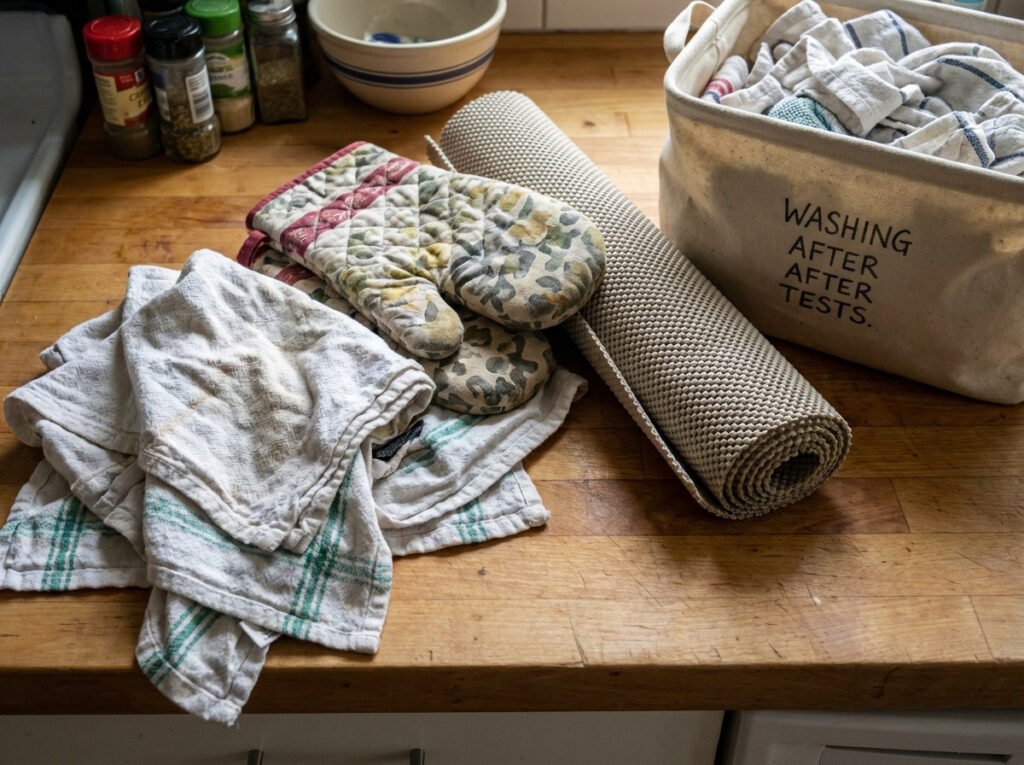
- Smell a dish towel, oven mitt, and floor mat.
- If those smell “like dinner,” they’re acting like sponges. Treat them first.
Test C — Hood Finish Test (60 seconds)
- Turn the range hood on (your normal setting).
- Stand at the front edge of the stove.
- If the odor seems to push outward or get worse, you likely have capture/airflow issues.
U.S. Environmental Protection Agency notes that using a range hood during cooking can greatly reduce indoor particle exposure, and specifically recommends leaving it on for 10–20 minutes after cooking.
(If your hood makes odors worse, read Range Hood Smells Worse When It’s On? Fix Backdrafting and “Reverse Odors”.)
Step 3 — Score the Reservoir (0–10)
Add points. Total them. Then pick the right fix.
- Paper towel from backsplash smells like the odor (+3)
- Hood underside feels sticky or smells oily (+2)
- Cabinet pulls near stove smell after a quick wipe (+1)
- Dish towels/mitts smell like the meal (+2)
- Floor mat smells like cooking when lifted (+1)
- Odor returns within 30 minutes after airing out (+1)
Score meaning
- 0–2: Reservoir is minor. Focus on airflow or an ongoing source.
- 3–5: Mixed. Do a light degrease + wash fabrics.
- 6–10: Reservoir is major. Do the full 48-hour reset.
Why Next-Day Odors Happen (In Plain English)
Cooking releases tiny particles and oily aerosols. Some leave through ventilation. Some land on surfaces. Over time, that film becomes a smell source.
That’s why “open a window for five minutes” often fails. You diluted the air. You didn’t remove what the smell is attached to.
The fix is simple:
- Remove grease film.
- Wash or isolate porous items.
- Vent correctly so the kitchen actually clears.
The 48-Hour Reset (Follow This Exactly)
Hour 0–2 (Today): Remove the Biggest Reservoirs
1) Degrease three high-impact zones (15–25 minutes)
Do them in order. Don’t jump around.
- Zone 1: Range hood underside + front lip
- Zone 2: Backsplash + wall beside the stove
- Zone 3: Cabinet pulls and cabinet faces closest to the stove
Spray. Wait 2–3 minutes (per label). Wipe. Then wipe once more with clean water. Dry.
2) Strip the fabric reservoirs (10 minutes active time)
Wash these today:
- Dish towels
- Oven mitts
- Floor mats near the kitchen
If you can’t wash immediately, bag them. Don’t leave them in place.

3) Run the hood correctly (zero effort, huge payoff)
Turn the hood on while you clean. Then leave it on 10–20 minutes after you finish cleaning/cooking.
(If your home feels stale even with windows open, read Why Does My House Feel Stuffy Even With Windows Open?)
Hour 2–24 (Tonight): Stop Re-Depositing Odor
1) Cook “low-deposit” for one night
Avoid frying or high-heat searing tonight if possible. Choose simmering, steaming, or oven baking with the hood running.
2) Add makeup air if capture feels weak
Crack a window 1–2 inches near the kitchen when you cook. This can reduce negative pressure and improve capture.
3) Don’t mask with fragrance
Skip candles and heavy sprays. They can add more chemicals to the air instead of solving the source. For broader low-cost air steps, see How to Improve Indoor Air Quality Without Expensive Equipment.
Hour 24–48 (Tomorrow): Lock the Win
1) Repeat a 5-minute wipe-down
Hit only:
- Backsplash behind stove
- Cabinet pulls nearest stove
2) Clean the filter if you skipped it
Dirty filters trap grease and can hold smell. Clean or replace based on your hood type.
3) Re-check for “non-cooking” sources
If the odor is sour, funky, or sewer-ish, check:
- Trash bin lid underside and bottom
- Sink cabinet for dampness
- Dishwasher area for old food funk
If you’re getting a musty/damp smell (not food), treat it like moisture. Centers for Disease Control and Prevention recommends keeping indoor humidity no higher than 50% and fixing leaks so mold doesn’t have moisture to grow.
(If you suspect damp cabinets, your upcoming cabinet article will be a perfect internal link later.)
If the Smell Keeps Coming Back (Use This Troubleshooting)
If the smell is strongest on walls/cabinets:
Degrease more often. Add a weekly 5-minute wipe routine.
If the smell is strongest in towels/mats:
Wash more frequently. Store clean towels away from the stove. Replace old mats.
If the smell is worse when the hood runs:
Treat it as airflow/backdraft. Read Range Hood Smells Worse When It’s On? Fix Backdrafting and “Reverse Odors.”
If the air feels heavy or hard to breathe after cooking:
Use stronger ventilation. Consider the broader decision path in Why Does the Air in My House Feel Thick or Hard to Breathe?
FAQ
Q1: Why does my house still smell like food the next morning?
Because odor is stored on grease film and porous items. Overnight, the air stops moving and the smell becomes more noticeable.
Q2: Why does the smell come back after I air out the kitchen?
You cleared the air, not the reservoir. Once airflow drops, stored odor releases again.
Q3: How long should I run my range hood after cooking?
U.S. Environmental Protection Agency recommends leaving it on for 10–20 minutes after cooking.
Q4: My food odor turned “musty.” Is that still cooking smell?
Usually not. Musty odor often points to moisture. Keep humidity controlled and fix leaks.
Q5: Is it normal to feel headaches or irritation after cooking?
It can happen, especially with poor ventilation and combustion sources. If it’s frequent, treat it as an indoor air quality issue.
Q6: What’s the fastest “good enough” fix if I’m busy?
Degrease the hood underside + backsplash, wash the dish towels, and run the hood 10–20 minutes after cooking.
Author Trust Block (standard)
Written by: WellZenx Editorial Team
Reviewed by: Home Environment Standards Editor (WellZenx)
Editorial standards: This article follows our Editorial Policy and fact-checking process.
Why trust this: We built this guide around an overnight “odor reservoir” model specific to next-day cooking smells: simple confirm tests (paper-towel grease wipe, fabric sniff checks, hood flip test), a 0–10 reservoir score to prioritize actions, and a 48-hour reset timeline designed to remove grease film and porous-item odor storage while improving post-cook ventilation. Recommendations align with EPA guidance on using kitchen exhaust during cooking and continuing ventilation afterward, plus moisture-control basics when odors shift from food-like to musty.
Medical disclaimer: This content is for general education and does not replace medical advice.
Last updated: February 12, 2026
Related pages: Editorial Policy • Corrections • Medical Disclaimer • About WellZenx