
Fast Diagnosis + Safe Fixes That Last
Published: February 12, 2026 (ET)
Updated: February 12, 2026 (ET)
You open the trash can and it hits you like a wall.
That “odor burst” usually means one thing:
Warm, trapped air is releasing a concentrated smell from a hidden source.
Most people scrub the bin once and hope. Then the smell comes back.
To fix it for good, do two things:
- Find the true source (it’s often not the bag).
- Remove the odor reservoir (film + leaks + damp spots).
Quick Safety Rules (Read This Once)
- Do not mix cleaners. Never mix bleach with ammonia or other products. It can release toxic gases.
- Ventilate while cleaning. Open a window or run an exhaust fan if the smell is strong.
- Skip heavy fragrance masking. Many scented products emit VOCs that can irritate sensitive people.
If odors trigger headaches or fatigue often, treat it as an indoor air issue and read Can Poor Indoor Air Quality Cause Headaches and Fatigue?
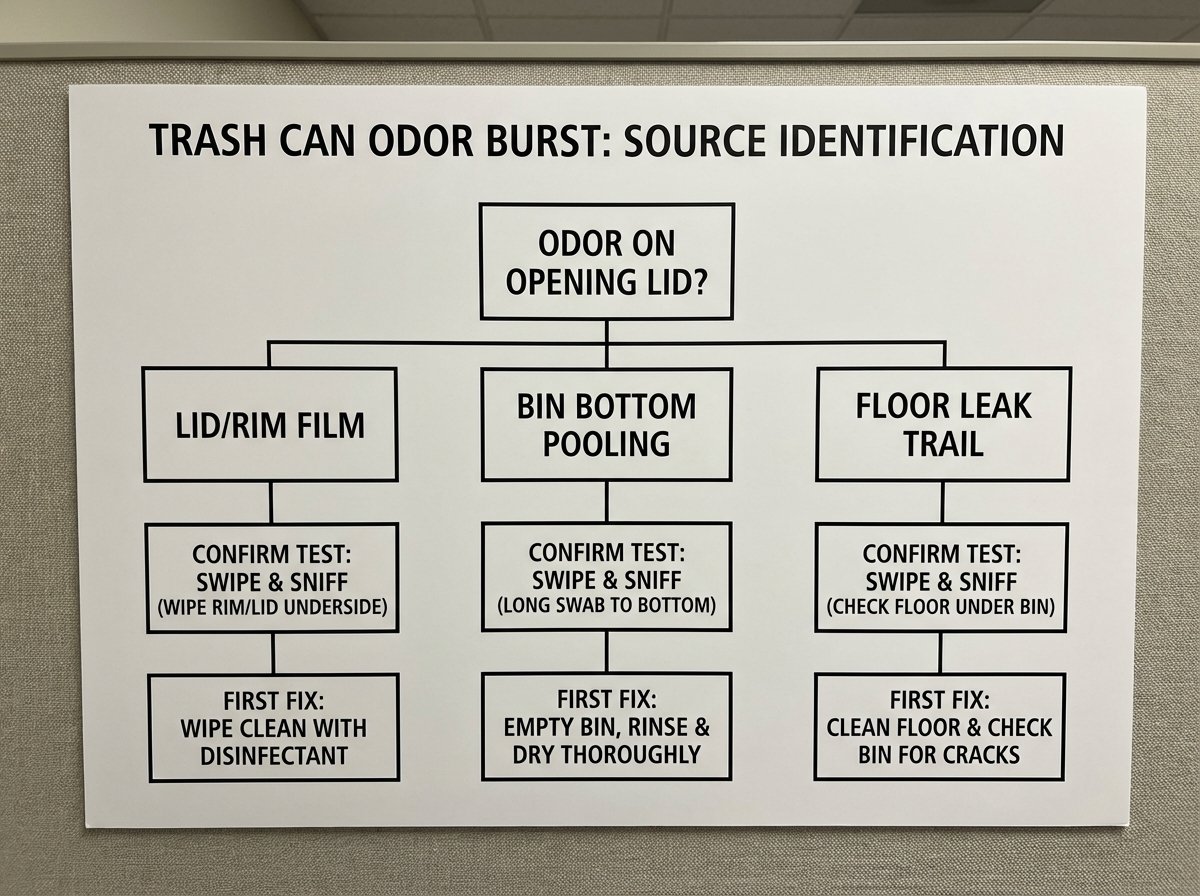
The WellZenx “Odor Burst Finder”
Use this when the smell “explodes” the second you lift the lid.
This takes 10 minutes and pinpoints the real source.
Step 1 — Do the Lid-Lift Countdown Test (60 seconds)
- Close the lid. Wait 30 seconds.
- Lift the lid 2 inches. Count to 3.
- Smell once. Then close it.
What it tells you
- Instant punch at 1–3 seconds: source is inside the can or lid (film, leak, residue).
- Smell ramps up after 5–10 seconds: odor may be outside the can (floor, cabinet, nearby drain, wall).
Step 2 — Run the 4-Point “Swipe & Sniff” Map (4 minutes)
Use a paper towel. Wipe each spot. Smell the towel.
- Lid underside (especially the rim and hinge area)
- Bin rim (where the bag touches)
- Bin bottom inside (where liquid pools)
- Floor under/behind the bin (the hidden leak zone)
Results
- Lid/rim smells strongest: you have a film reservoir.
- Bottom smells strongest: you have pooled liquid or micro-leaks.
- Floor smells strongest: you have a missed leak trail (common).
Step 3 — Score Your “Burst Risk” (0–8)
Add points. Then use the fix path below.
- Lid underside swipe smells strongest (+2)
- Rim swipe smells strong (+1)
- Bottom inside swipe smells strong (+2)
- Floor behind/under bin smells strong (+2)
- You see sticky spots or dried drip marks (+1)
Score meaning
- 0–2: light problem. Do a fast wash + dry.
- 3–5: medium. Remove film + fix leak points + dry-out.
- 6–8: heavy. Do the full 48-hour reset and change habits for 30 days.
Why Trash Smell “Explodes” (Plain English)
Trash odor builds when three things happen:
- Moisture shows up (food drips, condensation, wet coffee grounds).
- Bacteria get time (film forms on plastic and rubber).
- The lid traps it (warm air concentrates odor).
When you open the lid, you release that trapped air.
That’s why it feels like a burst.
10-Minute Diagnosis (Do This Before You Deep Clean)
Check 1 — Confirm it’s the trash can (30 seconds)
- Close the lid. Walk 10 feet away.
- Smell the room.
- Open the lid briefly. Smell again.
If the odor spike happens only with lid lift, keep going.
If the whole room smells even with lid closed, the source may be elsewhere.
If the odor is sewer-like (not “trash”), jump to Bathroom Floor Drain Smells? Fix Sewer Odor in 10 Minutes(And Keep It From Coming Back).
Check 2 — Identify the smell type (60 seconds)
Match the smell. Then focus your fix.
- Rotten food / sour: wet food residue, leak, bottom pooling
- Ammonia / urine-like: protein waste, cat litter, certain cleaners, or hidden residue
- Musty / damp: moisture problem near bin (floor, cabinet base)
If your home keeps getting ammonia-like odors, also read Bathroom Smells Like Urine/Ammonia That Won’t Go Away? Find the Hidden Source (Fast).
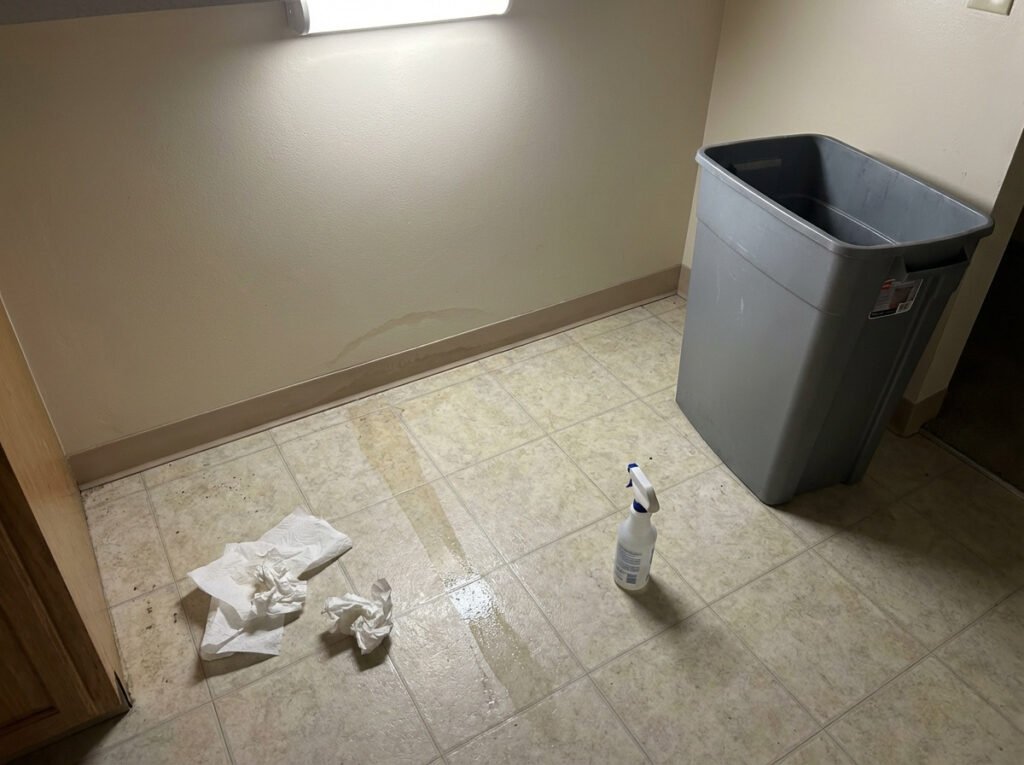
Check 3 — Find the hidden leak trail (2 minutes)
Look for clues:
- Sticky floor spots
- Dark drip marks along the bin side
- A “ring” where a bag leaked
Pull the bin away from the wall.
Check behind it. This is where smell often lives.
Fix Path A: Film Reservoir (Lid + Rim)
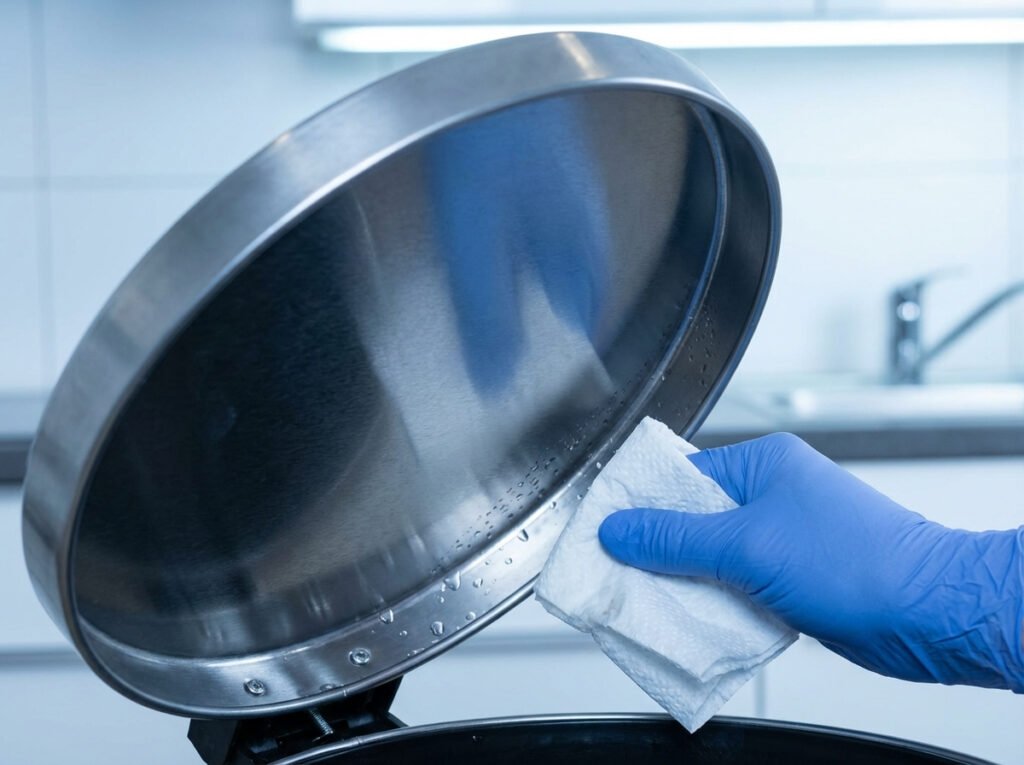
Choose this if the lid underside or rim swipe smelled worst.
Do this (10–15 minutes)
- Remove the bag. Take it outside.
- Wash the lid underside and rim first.
- Scrub seams and hinge areas. Film hides there.
- Rinse. Then dry completely.
Film + moisture is what keeps odor returning.
Drying matters more than people think.
Make it last (2 minutes)
- Wipe the rim weekly with a damp cloth, then dry.
- Keep the lid cracked for 30 minutes after dumping wet food scraps (only if safe/pets allow).
Fix Path B: Pooled Liquid (Bottom of Bin)
Choose this if the bottom swipe smelled worst or you see dampness.
Do this (10–20 minutes)
- Empty and rinse.
- Wash with hot soapy water.
- Scrub the bottom corners.
- Rinse thoroughly.
- Dry with a towel. Then air-dry 10 minutes.
Stop it from returning
- Double-bag wet food waste.
- Freeze messy scraps (meat packaging, shrimp shells) until trash day.
- Use smaller bags so trash goes out more often.
Fix Path C: Floor Leak Trail (Under/Behind the Bin)
Choose this if the floor swipe smelled worst.
Do this (10–15 minutes)
- Clean the floor under and behind the bin.
- Follow the drip trail. Wipe outward in a wider circle than you think.
- Dry the floor completely.
If you smell damp/musty around the bin base repeatedly, treat it like moisture. CDC recommends keeping indoor humidity low (no higher than 50%) and fixing leaks so mold does not have moisture to grow.
The 48-Hour Trash Odor Reset (For Stubborn “Exploding” Smell)
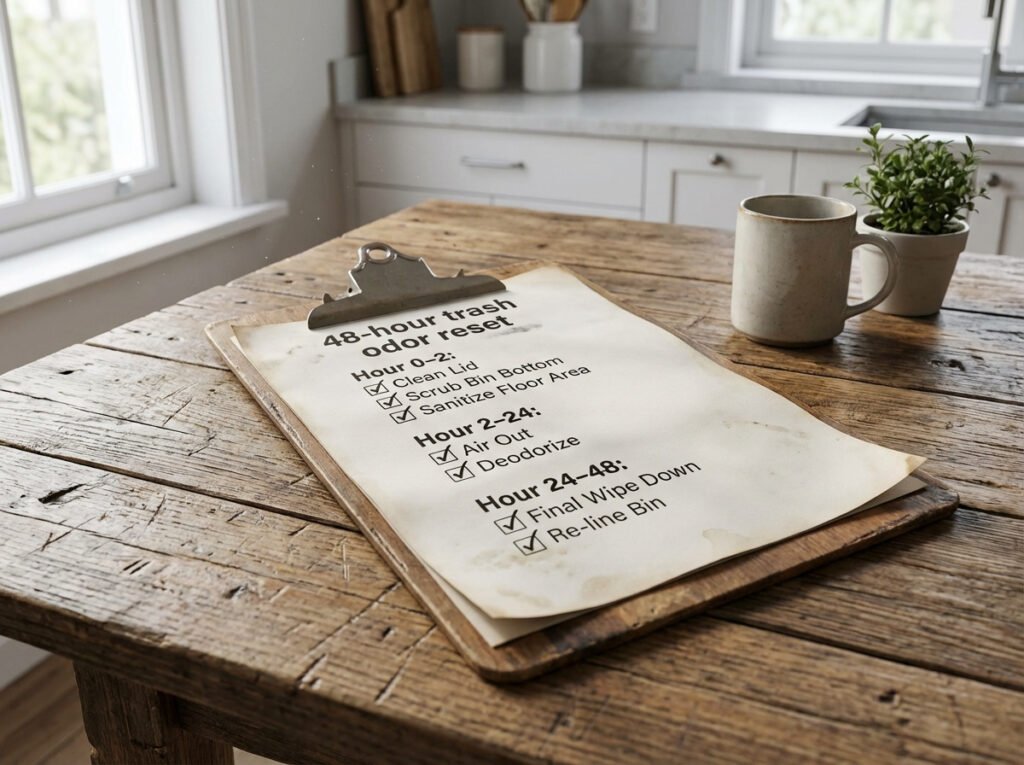
Hour 0–2 (Today): Remove the reservoir
- Run the WellZenx Odor Burst Finder.
- Clean the worst zone first (lid, bottom, or floor).
- Dry everything completely.
- Ventilate the area while cleaning. EPA notes ventilation helps dilute indoor pollutants from indoor sources.
Hour 2–24 (Tonight): Keep it dry
- Avoid adding wet waste directly.
- Bag wet scraps separately or freeze them.
- Wipe the rim once before bed if you had messy trash.
Hour 24–48 (Tomorrow): Lock it in
- Repeat a 2-minute lid/rim wipe.
- Check the floor again for missed drip spots.
- Reset your routine using the 30-day plan below.
30-Day Prevention Plan (So It Doesn’t Come Back)
Daily (30 seconds)
- Tie off wet waste. Don’t leave it open in the bin.
- Take out trash earlier if the kitchen is warm.
Weekly (3 minutes)
- Wipe lid underside + rim.
- Check the floor under the bin quickly.
Monthly (10 minutes)
- Wash and dry the bin.
- Replace worn rubber parts if the lid seal holds odor.
Reduce indoor irritation
If you’re sensitive to odors or headaches, avoid relying on scented sprays. EPA notes VOC concentrations can be higher indoors than outdoors, and many products can emit VOCs.
For broader low-cost indoor air steps, read How to Improve Indoor Air Quality Without Expensive Equipment.
If air still feels “heavy,” use Air Feels Thick to Breathe at Home: Humidity vs Stale Air vs Irritants (10-Minute Checks).
When to Escalate
Escalate if any of these are true:
- The smell is sewer-like or appears even when the bin is empty (check drains).
- You find repeated dampness in a cabinet base or flooring (moisture problem).
- The odor causes frequent symptoms (headache, nausea, irritation).
FAQ
Q1: Why does the trash smell worse when I open the lid?
Because the lid traps warm, concentrated air. Opening it releases a “burst” from the odor reservoir.
Q2: I changed the bag—why does it still stink?
Because the smell is often in the lid underside, rim film, bin bottom corners, or floor leak trail, not the bag.
Q3: What’s the fastest fix that actually lasts?
Clean and dry the lid underside + rim, then clean the bin bottom, then wipe the floor under/behind the bin. Dry everything fully.
Q4: Can I use bleach in the trash can?
You can, but use it carefully and never mix it with other cleaners. CDC warns never to mix bleach with ammonia or any other cleaner.
Also ventilate to avoid breathing fumes.
Q5: Why does the odor smell like ammonia?
Protein waste, cat litter, and residue can create sharp ammonia-like odors. If the smell persists outside the trash area, check other sources too (bathroom/cabinets).
Q6: My trash area smells musty. Is that still “trash smell”?
Often it’s moisture. CDC recommends keeping indoor humidity no higher than 50% and fixing leaks to prevent mold growth.
Author Trust Block
Written by: WellZenx Editorial Team
Reviewed by: Home Environment Standards Editor (WellZenx)
Editorial standards: This article follows our Editorial Policy and fact-checking process.
Why trust this: This guide is built specifically for “odor burst” trash can smells, using a simple, repeatable diagnostic method (lid-lift countdown test + four-point swipe-and-sniff map) to identify whether the source is lid film, bin-bottom pooling, or a hidden floor leak trail. Fixes prioritize source control, drying, and ventilation—aligned with EPA’s indoor air quality basics (source control and ventilation) and CDC safety guidance for bleach use and chemical mixing.
Medical disclaimer: This content is for general education and does not replace medical advice.
Last updated: February 12, 2026
Related pages: Editorial Policy • Corrections • Medical Disclaimer • About WellZenx