
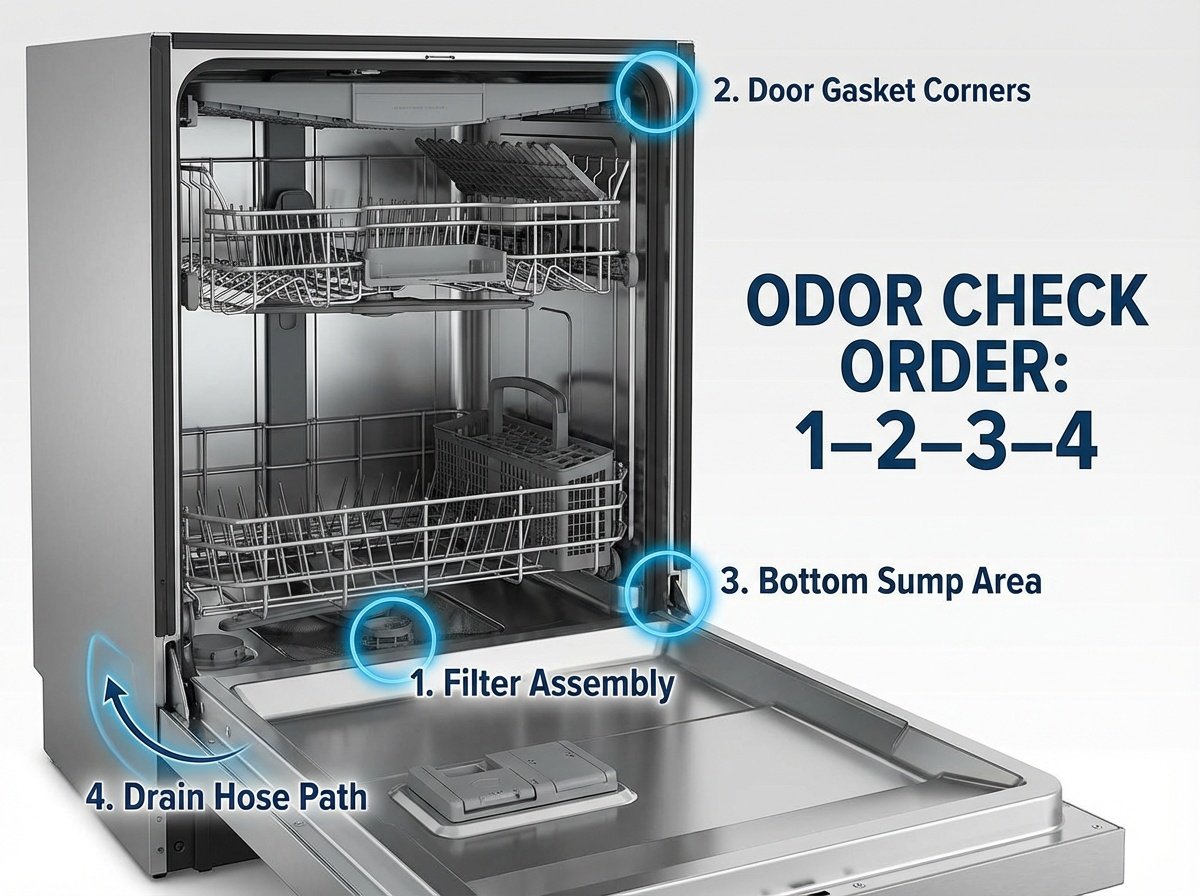
10-Minute Checks + Fix Options
Published: February 12, 2026 (ET)
Updated: February 12, 2026 (ET)
A dishwasher that smells bad right after a wash is usually telling you one of three things:
- Food is trapped (filter, sump, spray arm holes).
- A biofilm is holding odor (gasket, filter housing, drain path).
- Dirty water is sneaking back (drain loop/backflow/slow drain).
The good news: most “dishwasher stink” problems can be found in 10 minutes and improved in 48 hours—without buying anything.
Quick Safety Rules (Read Once)
- Don’t mix cleaners. Never mix bleach with ammonia or any other cleaner.
- Ventilate while cleaning. Open a window or run an exhaust fan if odors or fumes bother you.
- If strong odors trigger symptoms, treat it like an indoor air issue and read Can Poor Indoor Air Quality Cause Headaches and Fatigue?
The WellZenx 10-Minute Dishwasher Odor Finder
Use this when the smell is there even after a full cycle.
Goal: identify the “odor zone” so you clean the right thing first.
Step 1 — Name the smell (30 seconds)
Pick the closest match:
A) Sour / dirty dishwater
Usually trapped food + wet film.
B) Rotten eggs / sewer-ish
Usually drain/backflow or a plumbing odor nearby.
C) Musty / damp basement
Usually moisture sitting in the gasket area or standing water.
D) Burnt / hot plastic
Usually a heated dry issue, melted item, or something touching the heater (if your model has one). Stop and inspect before running again.
Step 2 — Run the “3-Zone Sniff” (2 minutes)
Open the dishwasher. Smell each zone once:
- Bottom center (sump area)
- Door gasket (rubber seal) and corners
- Filter area (remove the lower rack if needed)
Strongest zone = your first clean.
If all three smell the same, clean the filter first anyway (it’s the most common reservoir).
Step 3 — Do the “Filter Reality Check” (3 minutes)
- Pull the filter (check your manual if needed).
- Look for slime, grit, seeds, paper labels, glass bits, or gray paste.
- Rinse with warm water. Brush if needed. Reinstall.
Biofilms can develop on appliance surfaces (including rubber seals) and contribute to persistent odors.
Step 4 — Do the “Drain Backflow Quick Check” (3 minutes)
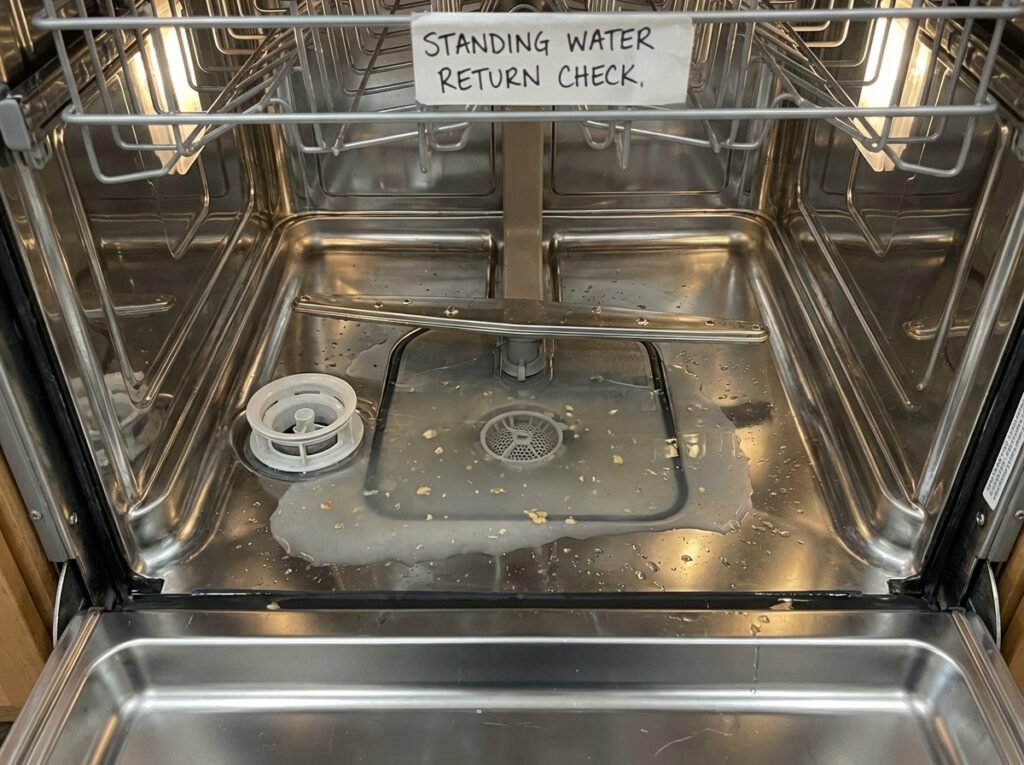
You’re looking for dirty water that returns after a cycle.
- Start a quick rinse cycle for 2–3 minutes.
- Cancel/stop it.
- Wait 60 seconds.
- Open the door and look at the bottom:
- If you see cloudy water sitting there, you may have a drain/loop/backflow problem.
If what you’re smelling is clearly sewer-like, jump to Shower Drain Smells? 10-Minute Tests + Fixes That Actually Work or Bathroom Floor Drain Smells? Fix Sewer Odor in 10 Minutes(And Keep It From Coming Back) (drain odor logic is often similar).
Step 5 — Score the “Odor Return Risk” (0–8)
Add points:
- Filter had visible gunk/slime (+2)
- Door gasket corners smelled strongest (+2)
- Standing water remained after cancel test (+2)
- You run “eco/low temp” cycles most of the time (+1)
- You rarely use heated dry (or door stays closed after cycle) (+1)
0–2: light issue → clean filter + air it out
3–5: medium issue → filter + gasket + hot clean cycle
6–8: heavy issue → do the full 48-hour reset + check drain setup
Why a “Clean” Dishwasher Can Still Smell
Dishwashers don’t just wash dishes. They also collect tiny bits of food, grease, and soap residue. Those leftovers create a thin film that can hold odor—especially in warm, damp places like seals, filters, and drains.
That’s why you can run a cycle and still get hit with a smell when you open the door.
Research and microbiology reviews note that microbes can persist on appliance surfaces in biofilms and produce odor-causing compounds.
10-Minute Checks (Do These Before You Deep-Clean)
Check 1 — Filter first (2–4 minutes)
Remove and rinse the filter.
If the smell drops noticeably after you reinstall it, you just found the main reservoir.

Check 2 — Gasket corners (1 minute)
Run a finger (gloved) along the door gasket corners.
If it feels slick or smells stronger there, that’s a film reservoir.
Check 3 — Spray arm holes (1 minute)
Spin the spray arms. Look for blocked holes.
Food bits can rot and smell.
Check 4 — Standing water (2 minutes)
Look for water that sits at the bottom long after a cycle.
Standing water usually means a drain problem or backflow.
If your whole home feels stuffy when odors show up, see Why Does My House Feel Stuffy Even With Windows Open?
Fix Options (Pick the Path That Matches Your Tests)
Fix Path A — Filter + Sump Cleanup (Most common)
Do this if the filter smelled worst or had visible gunk.
- Remove the filter.
- Rinse with warm water. Brush gently.
- Wipe the filter housing area with a damp cloth.
- Reinstall.
Fast win: run a hot cycle after cleaning so the machine flushes loosened residue.
Fix Path B — Door Gasket Film Cleanup
Do this if gasket corners smelled worst.
- Wipe the gasket with warm soapy water.
- Wipe again with clean water.
- Dry it.
Don’t leave the gasket wet. Drying is part of the fix.
Fix Path C — Hot “Clean Cycle” Reset
Do this if odors keep coming back or your score is 3+.
A common manufacturer-style approach is:
- Run a cycle with vinegar placed upright in a dishwasher-safe container, then
- Follow with baking soda in a separate cycle.
(Do not mix products together. Run them as separate steps.)
Fix Path D — Drain/Backflow Setup Check
Do this if you see standing water return after draining.
- Look under the sink for a high loop or air gap (varies by install).
- Check for kinked drain hose.
- Clean the garbage disposal if your dishwasher drains into it (trapped gunk can smell).
If you suspect drain odors, the drain guides will help:
Dry-Area Floor Drain Smells? 10-minute tests + fixes that last and Bathroom Floor Drain Smells? Fix Sewer Odor in 10 Minutes(And Keep It From Coming Back).
The 48-Hour Dishwasher Odor Reset (Works Even If You’re Busy)
Hour 0–2 (Today): Remove the reservoir
- Clean the filter.
- Wipe gasket corners.
- Check spray arms for debris.
- Run one hot cycle to flush.
Ventilation helps dilute indoor pollutants from indoor sources, especially if you’re using cleaners.

Hour 2–24 (Tonight): Let it dry
- When the cycle ends, crack the door open for 30–60 minutes (if safe).
- Don’t trap moisture overnight. Dampness feeds odor.
Hour 24–48 (Tomorrow): Deepen only if needed
If the smell is still there:
- Run the vinegar cycle + baking soda cycle method (separate steps).
- Re-check for standing water return.
30-Day Prevention (So It Stays Fresh)
Weekly (2 minutes)
- Rinse the filter under warm water.
- Wipe gasket corners.
Monthly (10 minutes)
- Do a hot clean cycle.
- Inspect spray arms.
Habit upgrades that actually matter
- Scrape big food chunks off plates (you don’t need to pre-wash everything).
- Avoid always running low-temp cycles if odor keeps returning.
- Let the dishwasher dry out after the last load of the day.
For broader low-cost air and odor control habits, read How to Improve Indoor Air Quality Without Expensive Equipment.
If indoor air feels “heavy” when odors show up, air feels thick or hard to breathe
When to Escalate
Escalate if any of these are true:
- You smell burnt plastic or electrical odor repeatedly.
- Standing water returns every time.
- Sewer odor persists even after filter cleaning (plumbing/drain setup likely).
- Odors trigger frequent symptoms (headaches, nausea, irritation).
FAQ
Q1: Why does my dishwasher stink even after a wash?
Because the smell is usually stored in the filter, gasket corners, or drain path—not on the dishes.
Q2: What’s the fastest fix?
Clean the filter and wipe the gasket corners. Then run one hot cycle to flush.
Q3: Is vinegar and baking soda safe?
Many manufacturer guides recommend running them as separate steps (not mixed together).
Q4: Why does it smell worse when I first open the door?
Warm, humid air releases trapped odors all at once. That’s why drying matters.
Q5: The smell is sewer-like—what does that mean?
It often points to backflow, a drain issue, or nearby plumbing odors. Use the drain guides: Shower Drain Smells? 10-Minute Tests + Fixes That Actually Work.
Q6: I used bleach—why does it smell harsh?
Bleach fumes can irritate. Ventilate, and never mix bleach with ammonia or any other cleaner.
Author Trust Block
Written by: WellZenx Editorial Team
Reviewed by: Home Environment Standards Editor (WellZenx)
Editorial standards: This article follows our Editorial Policy and fact-checking process.
Why trust this: This guide uses a dishwasher-specific “odor zone” approach—filter/sump, door gasket corners, and drain/backflow—paired with a 10-minute diagnostic sequence (odor fingerprint + 3-zone sniff + standing-water check) so readers clean the right reservoir first. Fix options reflect common manufacturer-style cleaning steps (separate vinegar then baking soda cycles) and are framed with safety and ventilation basics, including CDC guidance to never mix bleach with ammonia/other cleaners and EPA guidance that ventilation helps dilute indoor pollutants from indoor sources.
Medical disclaimer: This content is for general education and does not replace medical advice.
Last updated: February 12, 2026
Related pages: Editorial Policy • Corrections • Medical Disclaimer • About WellZenx