
10-Minute Tests + Fixes That Work in Apartments and Condos
Published: February 13, 2026 (ET)
Updated: February 13, 2026 (ET)
If your neighbor cooks and your place instantly smells like their dinner, you’re not “imagining it.”
Odors move with air.
In most apartments and condos, cooking smells get in through one (or more) of these:
- Door gaps (hallway air gets pulled into your unit)
- Shared shafts (pipes, vents, chases, electrical openings)
- Pressure imbalances (your unit runs negative and “sucks” air in)
- Leaky exhaust paths (bath fan or kitchen hood pulls from the corridor/shaft)
You don’t need a complex inspection to start.
You need two things:
- Prove where air is entering.
- Reduce the pressure and leakage that makes intrusion happen.
First: 60-Second Safety and Reality Check
- If the odor triggers headaches, nausea, or breathing irritation, treat it like an indoor air problem and read Can Poor Indoor Air Quality Cause Headaches and Fatigue?
- If the smell is smoke (not food), you may need a building policy conversation. (The airflow steps below still help.)
Ventilation can dilute indoor pollutants, but it can also pull in outdoor (or hallway) pollutants if the source is nearby.
That’s why the goal is controlled airflow, not “open everything and hope.”
The WellZenx “Odor Intrusion Path Finder”
Use this when the smell seems to come “from nowhere.”
This takes 10 minutes and tells you what to fix first.
Step 1 — Do the Pressure Flip Test (2 minutes)
This test tells you whether your unit is acting like a vacuum.
Do this:
- Close your windows. Close your front door.
- Turn ON your bathroom exhaust fan.
- Turn ON your kitchen hood (if you have one).
- Wait 30 seconds.
- Walk to your front door and sniff near the door edges.
What it means:
- If the smell gets stronger with fans ON, your unit is likely negative and pulling air in through leaks.
- If the smell weakens with fans ON, intrusion may be coming from another route (shaft/vent) or timing.
Pressure differences drive airflow through leaks. Wind and building pressure patterns can create strong pressure differences that move air through holes and cracks.
Step 2 — Do the Door Gap Draft Test (2 minutes)
This test finds the easiest entry point.
Do this:
- Close the front door.
- Hold a thin tissue strip or a piece of toilet paper near:
- the bottom sweep
- the latch side
- the hinge side
- the door frame corners
- Turn your bathroom fan ON and OFF.
What it means:
- If the tissue pulls inward when fans are ON, hallway air is being pulled into your unit.

Step 3 — Run the 5-Spot Entry Scan (4 minutes)
Odors often travel through hidden openings.
Check these five spots quickly:
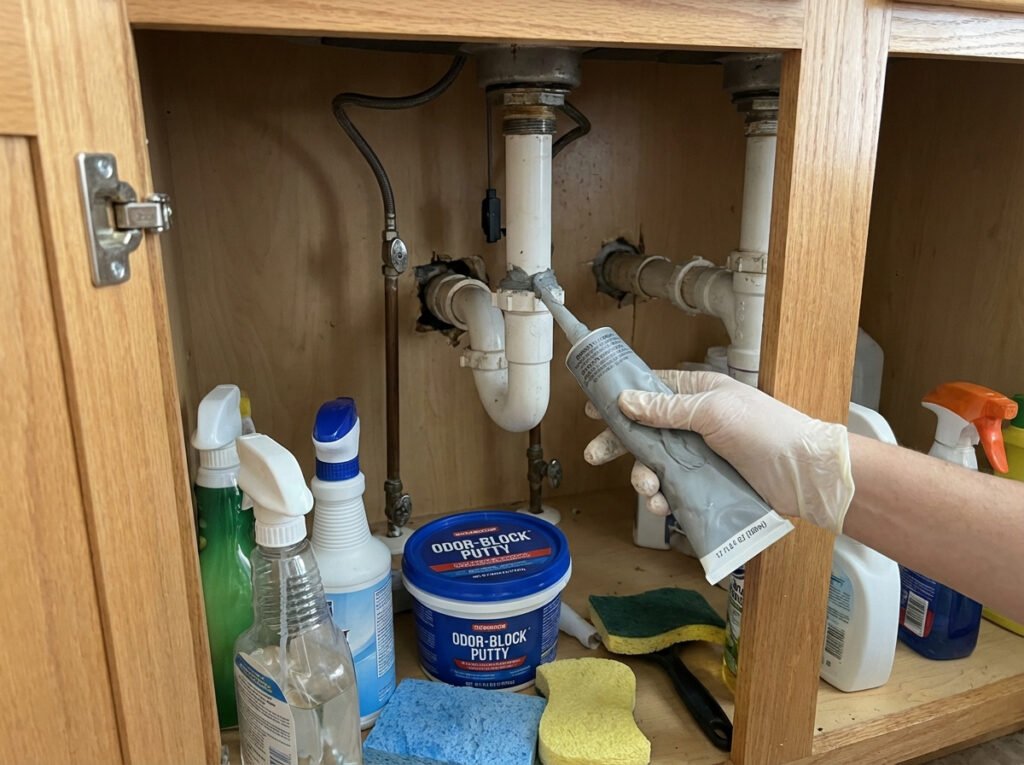
- Around plumbing under the kitchen sink (pipe cutouts)
- Behind the dishwasher (toe-kick area)
- Around the stove hood cabinet (gaps around duct or wiring)
- Electrical outlets on shared walls (especially near the kitchen)
- Any access panels (water heater closet, HVAC closet)
Fast clue: If the smell is strongest near one of these spots, that’s a major entry path.
Building pressure fields and leakage paths (including shafts and demising walls) can pull air from shared spaces when exhaust systems run and ducts leak.
Step 4 — Score Your Intrusion Risk (0–10)
Add points. Then pick the fix path.
- Door gap draft pulls inward with fans ON (+3)
- Odor strongest at sink pipe cutouts (+2)
- Odor strongest at toe-kick/dishwasher side (+2)
- Odor strongest at outlets/shared wall (+1)
- Smell increases when multiple exhaust fans run (+2)
0–2: minor → quick sealing + better timing
3–6: moderate → door sealing + key penetrations + airflow tweaks
7–10: major → needs building-level help plus your unit fixes
Why This Happens (Plain English)
Odor particles ride on moving air.
Air moves because of pressure differences.
Pressure differences can come from:
- Wind pushing on the building (positive on one side, negative on the other)
- Exhaust fans pulling air out of your unit
- Stack effect (warm air rising)
- Leaks in shafts or ducts that change pressures in walls and corridors
So the fix is not one magic product.
It’s a short list of boring wins:
- Seal the easiest leaks.
- Reduce negative pressure when smells are happening.
- Improve filtration or dilution without pulling in more hallway air.
If your home often feels “stuffy” and you run exhaust constantly, your pressure balance may already be off. Read Why Does My House Feel Stuffy Even With Windows Open?
10-Minute Tests (Do These Before Buying Anything)
Test A — “Fans On vs Fans Off” Smell Change (2 minutes)
- Smell near the front door with everything OFF.
- Turn ON the bathroom fan for 60 seconds. Smell again.
- Turn ON the kitchen hood too (if you have one). Smell again.
If odor gets worse as exhaust increases, treat this as negative pressure + leakage.
Test B — “Hallway Sniff” Confirmation (1 minute)
Open your front door briefly (2–3 seconds).
Smell the hallway air.
If the hallway smells like cooking and your door has gaps, you have a direct path.
Test C — “One-Room Isolation” (3 minutes)
Close the kitchen door (or use a temporary barrier if you don’t have one).
- Does odor still reach the bedroom?
If yes, it’s likely spreading through a central path (hallway air pulled into the unit, HVAC return, or shared shafts).
If air feels heavy or hard to breathe during odor events, read Why Does the Air in My House Feel Thick or Hard to Breathe?
Test D — “Leak Hotspots” Touch Check (4 minutes)
Feel for moving air with the back of your hand:
- along the door edges
- around sink pipes
- at toe-kick gaps
- near outlets on shared walls
If you feel a draft, you’ve found a priority seal point.
Fix Path 1: Stop the Door From Acting Like an Air Intake
Choose this if door gaps are the main draft.
Do this first (15–30 minutes)
- Add a door sweep at the bottom if there’s a visible gap.
- Add adhesive weatherstripping along the latch side and top if you see light or feel airflow.
- Make sure the door still latches cleanly.
Goal: stop hallway air from being the easiest route.
Do this next (5 minutes)
During peak odor times:
- Avoid running multiple exhaust fans at once.
- Run only what you need.
This isn’t “never ventilate.”
This is “don’t create a vacuum while the hallway smells.”

Fix Path 2: Seal the Hidden Openings That Feed Odor
Choose this if the smell is strongest near pipes, toe-kicks, or outlets.
Under-sink pipe cutouts (high impact)
- Seal gaps around pipes with removable solutions when possible.
- Focus on large openings first.
Toe-kick / dishwasher side
- Check for open gaps into the cavity behind cabinets.
- If there’s a large void, it can connect to shared spaces or a shaft.
Outlets on shared walls
- Drafts often come through wall cavities.
- Use draft-reducing outlet gaskets if your local codes and building rules allow.
Keep it simple: seal the largest, stinkiest gaps first.
Fix Path 3: Reduce Intrusion Without Making It Worse
Choose this if you can’t fully seal, or the building layout is complex.
Option A — Use controlled dilution (not random airing-out)
Ventilation removes indoor pollutants, but you should evaluate it carefully when outdoor or nearby sources of pollution exist (like smoke or refuse).
Hallway cooking odor counts as a nearby source.
Do this instead:
- Use a portable air cleaner in the room where odors are worst.
- Keep windows closed during peak hallway odor time if opening them increases infiltration from outside.
For a practical setup that doesn’t require expensive gear, read How to Improve Indoor Air Quality Without Expensive Equipment.
Option B — Time your exhaust better
If odors hit at predictable times (e.g., 6–8pm):
- Avoid heavy exhaust use right at that window.
- Use exhaust later, once hallway odor drops.
Option C — Check your range hood behavior
Some homes spread odor faster when the hood runs (capture problems or airflow patterns).
If that’s you, read Range Hood Smells Worse When It’s On? Fix Backdrafting and “Reverse Odors”.
A 48-Hour Plan (Fast Improvement Without Renovations)
Hour 0–2 (Today): Confirm and block the biggest path
- Run the Pressure Flip Test.
- Run the Door Gap Draft Test.
- Install a temporary door sweep or draft blocker if you have one.
- Seal one obvious pipe cutout under the sink if it’s a major odor hotspot.
Hour 2–24 (Tonight): Reduce vacuum effects
- During odor events, avoid stacking exhaust fans.
- Keep the door area sealed.
- Use a portable air cleaner in the room where you notice it most.
Hour 24–48 (Tomorrow): Lock in the best fixes
- Add weatherstripping if drafts are obvious.
- Seal the second-worst hotspot (toe-kick or outlet wall).
- Re-run the same tests and compare results.
Write down what changed.
Repeat what works.
Talking to Your Building (Short Script That Gets Results)
If your intrusion score is 7–10, you likely need building help.
Keep the request factual. Keep it measurable.
What to say:
- “Cooking odors are entering my unit from the corridor/shafts.”
- “The odor increases when my exhaust fans run, which suggests pressure and leakage pathways.”
- “I’m requesting an inspection of door seals, corridor pressurization, and known leakage points (pipe penetrations/shafts).”
Pressure and leakage interactions can change corridor-to-suite differentials and drive transfer through openings.
When to Escalate
Escalate if:
- Odors are frequent and intense despite sealing.
- You suspect the source is smoke (health risk is higher).
- Anyone in the home has worsening symptoms linked to the odor events.
In those cases, you still do your unit sealing, but you also document timing and intensity and bring it to management.
FAQ
Q1: Why do I smell my neighbor’s cooking through my closed door?
Because your unit is pulling in corridor air through gaps. Pressure differences move air through leak sites.
Q2: Why does it get worse when I turn on the bathroom fan?
Bathroom fans exhaust air. If your unit is leaky, that can create negative pressure and pull air from the hallway or shafts.
Q3: Will air fresheners solve this?
They mask odors. They don’t stop airflow. Some products can add VOCs that irritate sensitive people.
Q4: What’s the fastest fix?
Seal the door bottom and latch side first. Then seal the worst pipe cutout hotspot under the sink.
Q5: Should I open windows when it happens?
Only if it improves. Ventilation can help dilute pollutants, but it can also bring in nearby sources depending on conditions.
Q6: How do I know if the problem is a building shaft?
If odor is strongest at pipe cutouts, toe-kicks, or outlet walls, and sealing the door doesn’t help much, a shared cavity/shaft path is likely.
Author Trust Block
Written by: WellZenx Editorial Team
Reviewed by: Home Environment Standards Editor (WellZenx)
Editorial standards: This article follows our Editorial Policy and fact-checking process.
Why trust this: This guide treats “neighbor cooking smell” as an airflow problem first, using a unit-specific diagnostic sequence (pressure flip test, door-gap draft test, five-spot entry scan, and a 0–10 intrusion score) to identify whether odors are entering through door leakage, shared cavities/shafts, or pressure-driven pathways. Recommendations are grounded in EPA’s indoor air guidance on ventilation tradeoffs near pollution sources and building-science explanations of pressure differences driving airflow through leak sites, with practical, renter-friendly sealing priorities that can be verified by re-running the same tests.
Medical disclaimer: This content is for general education and does not replace medical advice.
Last updated: February 13, 2026
Related pages: Editorial Policy • Corrections • Medical Disclaimer • About WellZenx