
10-Minute Source Test + 48-Hour Reset + 30-Day Plan
Published: February 13, 2026 (ET)
Updated: February 13, 2026 (ET)
If you wipe surfaces and the dust is back the next day, you’re not failing at cleaning.
You’re dealing with dust “inputs” that outpace your cleaning “outputs.”
Daily dust rebound usually comes from a short list:
- Air leaks that pull dusty air in (doors, windows, wall gaps)
- Indoor shedding (textiles, paper, pets, skin flakes)
- Resuspension (walking, vacuuming, fans) that keeps dust airborne
- Weak filtration (HVAC filter, no air cleaner, poor capture)
The fix isn’t “clean harder.”
The fix is: find your biggest dust input, then block it.
Quick Reality Check (60 seconds)
Answer these fast:
- Dust shows up near windows/door edges first → think entry + air leaks
- Dust shows up on TV stand, shelves, bedroom nightstands → think airborne dust + weak filtration
- Dust shows up right after vacuuming → think resuspension or vacuum exhaust
- Dust is worst in one room → think a local source (laundry, litter, textiles, a leaky window)
If dust events come with headaches or fatigue, treat it like an air quality problem too: Can Poor Indoor Air Quality Cause Headaches and Fatigue?
The WellZenx “Daily Dust Rebound Finder”
Use this to answer one question:
“Where is today’s dust actually coming from?”
Time: 10 minutes now + 24 hours later
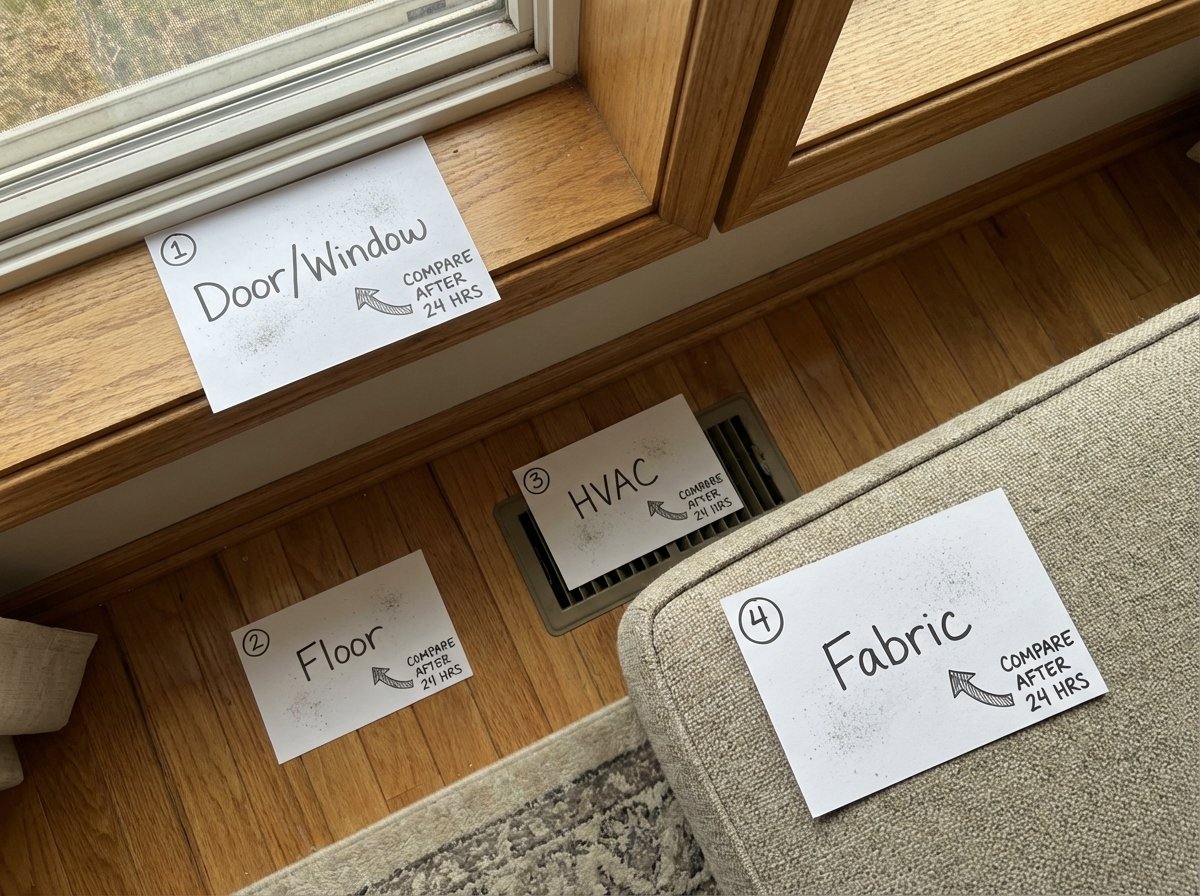
Part 1 — Set up four dust “check cards” (5 minutes)
Grab four white index cards (or white paper). Label them:
- Door/Window Card (place near the leakiest door or window)
- Floor Card (place on a low shelf near a high-traffic floor area)
- HVAC Card (place near a supply vent or return grille)
- Fabric Card (place near a couch, curtains, or a bed)
Leave them untouched for 24 hours.
Part 2 — Do the 3 quick tests (5 minutes)
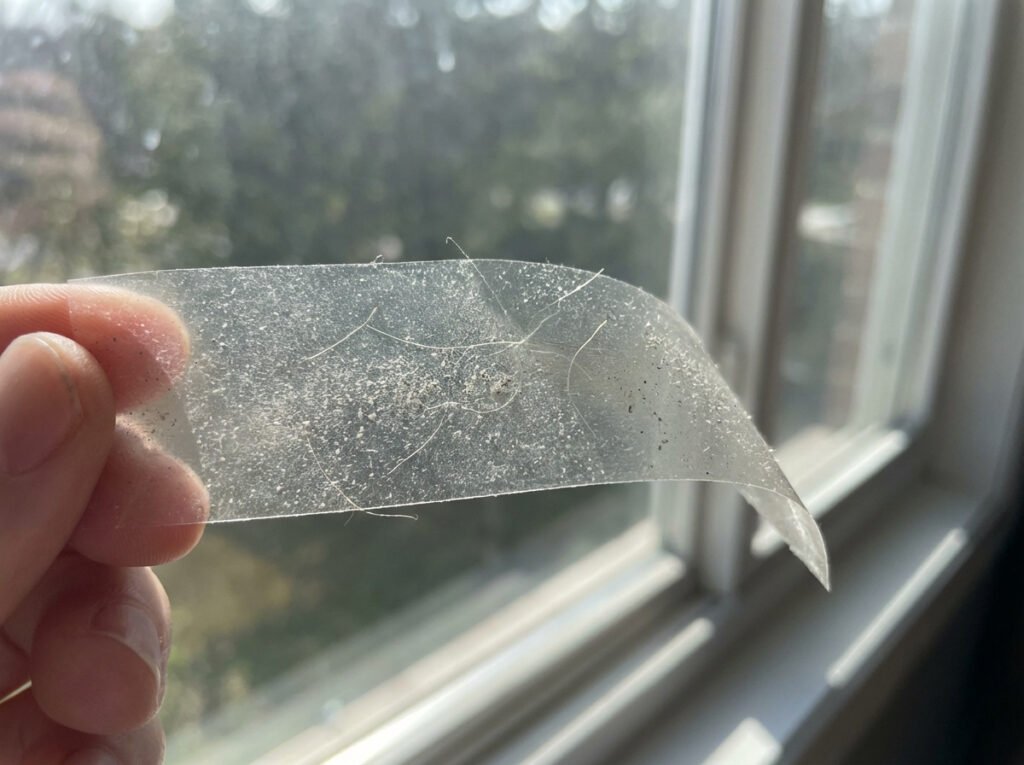
Test A — Tape Lift Test (60 seconds)
Press clear tape onto your dustiest surface. Lift it.
Look at the tape in bright light.
- Mostly gray/fine → more airborne/entry dust
- Lots of fibers/hair → more indoor shedding (textiles/pets)
Test B — Fan Burst Test (60 seconds)
Turn on a fan for 30 seconds in the dusty room.
Watch for visible floaters in a sunbeam.
- Lots of floaters → dust is being resuspended easily
- Few floaters → dust is settling from air slowly over time
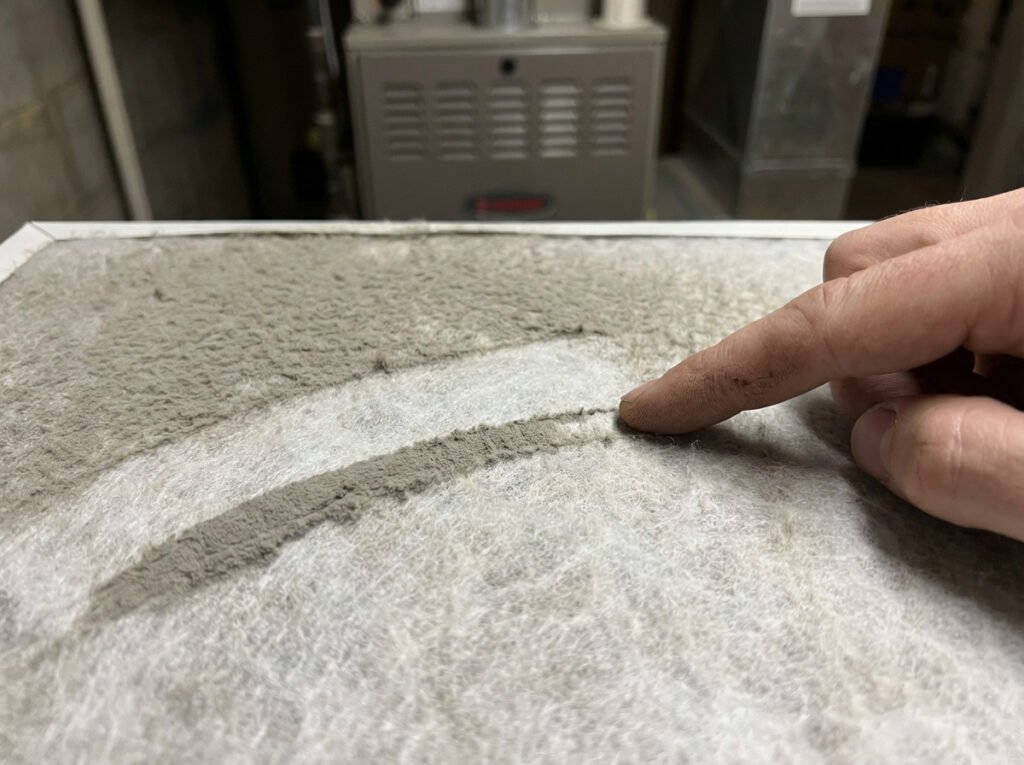
Test C — HVAC Filter Finger Test (2 minutes)
Check your HVAC filter (or the system filter if you have central air).
Run a finger across the intake side.
- Heavy gray load fast → filtration may be weak or air leaks are feeding dust
EPA’s home air cleaner guide covers how HVAC filters and portable air cleaners can reduce particles in the home.
Part 3 — Read your “check cards” tomorrow (2 minutes)
After 24 hours, compare cards:
- Door/Window Card is worst → your #1 fix is sealing + entry control
- HVAC Card is worst → your #1 fix is filtration + duct/return cleanliness
- Fabric Card is worst → your #1 fix is textile shedding + vacuum method
- Floor Card is worst → your #1 fix is resuspension + shoe/traffic habits
This turns “dust everywhere” into one clear priority.
Why Dust Comes Back So Fast (Plain English)
Dust isn’t one thing. It’s a mix: tiny particles, fibers, skin flakes, soil tracked in, and debris stirred up by movement.
Two key ideas matter:
- Dust settles, then gets kicked back up.
- If you only wipe surfaces, you never reduce the inputs.
EPA notes that vacuuming can stir up dust, and recommends a vacuum with a HEPA filter to reduce dust build-up.
That’s a big clue: the method matters as much as the frequency.
10-Minute Checks (Do These Before Buying Anything)
Check 1 — Locate the “first dusty” zone (2 minutes)
Wipe three spots now. Recheck tomorrow morning:
- Window sill
- TV stand or shelf at chest height
- Floor baseboard near a hallway
The spot that re-dusts first is your highest input.
Check 2 — Check for entry dust (3 minutes)
Look for these patterns:
- Dust line on the inside edge of a door
- Dust build-up on window tracks
- Dust concentrated near baseboards on exterior walls
If your home also feels stuffy with windows open, pressure and airflow are likely part of the story: Why Does My House Feel Stuffy Even With Windows Open?
Check 3 — Check for indoor shedding (3 minutes)
Do a fast audit:
- Lots of throw blankets, fabric sofas, heavy curtains
- Laundry baskets in bedrooms
- Pet bedding in the dusty room
If the tape lift shows fibers, focus here first.
Check 4 — Check humidity (2 minutes)
High humidity can make dust feel heavier and can support dust mites in bedding.
EPA recommends keeping indoor humidity below 60% (ideally 30–50%).
If you’re seeing high readings, read Is High Indoor Humidity Bad for Your Health?
Fix Paths (Pick the One That Matches Your Dust Finder)
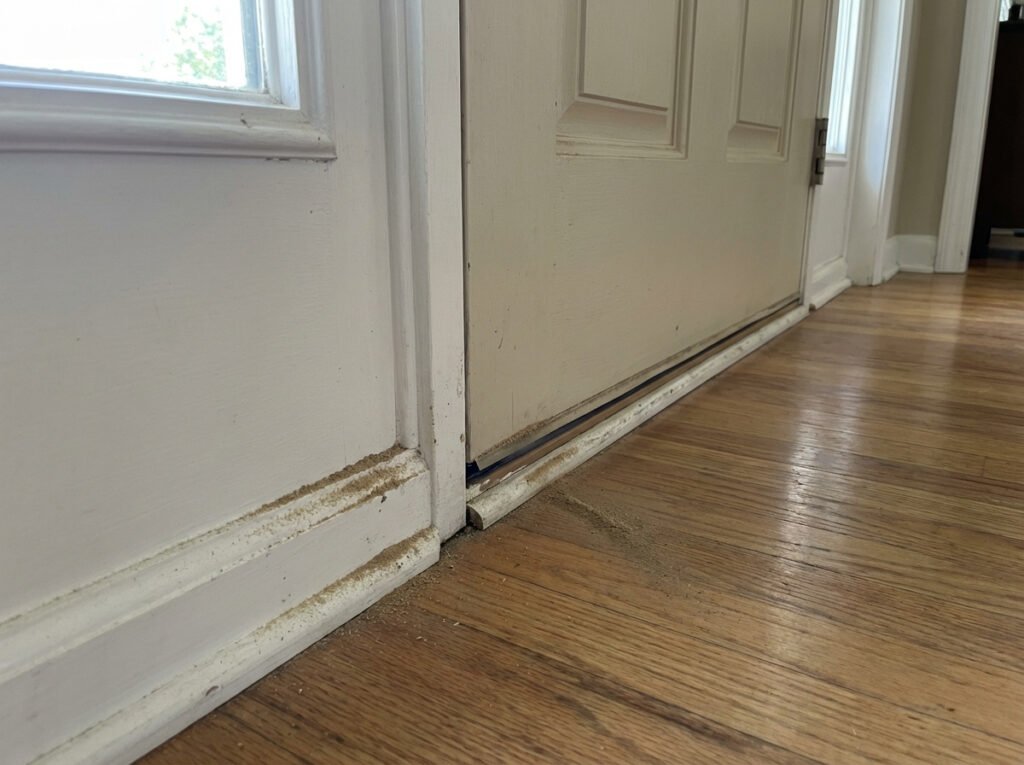
Fix Path A — Entry Dust (door/window card worst)
Goal: stop dust from entering, then clean what’s already inside.
Do this first:
- Seal obvious door bottom gaps (sweep or draft blocker).
- Clean window tracks. Then keep them dry and clear.
- Reduce “open door time” during windy hours if outside air is dusty.
Do this next:
- Clean from top down once, so you don’t re-soil lower surfaces.
Fix Path B — Weak Filtration (HVAC card worst)
Goal: remove dust from air before it settles.
Do this first:
- Replace or upgrade your HVAC filter (if you have central HVAC).
- Vacuum and wipe the return grille.
Do this next:
- Consider a portable air cleaner for the dustiest room.
EPA’s guide explains how portable air cleaners and HVAC filters can reduce particles in the home.
If you want a “no-shopping-first” approach, start with How to Improve Indoor Air Quality Without Expensive Equipment.
Fix Path C — Resuspension (floor card worst, floaters in sunbeam)
Goal: stop kicking dust back into the air.
Do this first:
- Switch to damp dusting (microfiber lightly damp).
- Vacuum slowly. Don’t “race.”
EPA notes people with asthma/allergies should avoid the area being vacuumed because dust can be stirred up, and suggests HEPA-filter vacuums to reduce dust build-up.
Do this next:
- Reduce high-speed fans that blast dust off surfaces during peak dusty periods.
Fix Path D — Textile/Pet Shedding (fabric card worst)
Goal: reduce fiber shed and capture what sheds.
Do this first:
- Wash throw blankets and pillow covers weekly for 2–3 weeks.
- Vacuum upholstery with a brush attachment.
Do this next:
- Groom pets more often (outside, if possible).
- Keep pet bedding washable and clean.
If air feels thick during cleaning, use Air Feels Thick to Breathe at Home: Humidity vs Stale Air vs Irritants (10-Minute Checks).
The 48-Hour Dust Reset (Simple and Repeatable)
Hour 0–2 (Today): Remove what’s already settled
- Dry vacuum floors slowly (best you have; avoid blasting).
- Damp dust high surfaces (tops of shelves, door trim).
- Wipe mid-level surfaces (TV stand, desks).
- Finish with baseboards.
If vacuuming makes symptoms flare, keep sensitive people out of the room while you vacuum.
Hour 2–24 (Tonight): Keep dust from re-entering
- Close the biggest entry gap (door sweep/draft blocker).
- Keep windows closed during visibly dusty outdoor periods.
- Run your HVAC fan on a normal schedule (if available) to filter air.
Hour 24–48 (Tomorrow): Lock the win
- Recheck your 3 “first dusty” spots.
- If one zone keeps rebounding, fix that zone (seal, filter, or shedding source).
- Repeat a quick damp-dust pass on the worst area only.
30-Day Plan (So You Stop Cleaning Every Day)
Weekly (15 minutes total)
- Replace or rinse filters per your system needs (HVAC or air cleaner). EPA provides selection tips for filters and air cleaners.
- Wash bedding/throws that shed fibers.
- Vacuum high-traffic floors slowly.
Monthly (20 minutes)
- Clean window tracks.
- Vacuum upholstery seams.
- Wipe return grilles and nearby walls.
Two habits that change everything
- Reduce shoes-on traffic.
- Declutter flat surfaces (dust lands where it can settle).
When to Escalate
Escalate if any of these are true:
- Dust rebounds within hours and you see obvious drafts (building leakage issue).
- Symptoms are frequent (wheezing, headaches, fatigue).
- You suspect renovation dust or unusual sources (construction nearby, heavy soot).
In those cases, focus on entry control and filtration first.
FAQ
Q1: Why does dust come back the next day after cleaning?
Because your dust inputs (entry, shedding, resuspension) are higher than what your cleaning removes.
Q2: Is it better to dust dry or damp?
Damp dusting captures dust instead of pushing it into the air.
Q3: Does vacuuming make dust worse?
It can if the vacuum leaks dust back into the room or if it stirs dust aggressively. EPA notes vacuuming can stir up dust and recommends HEPA-filter vacuums to reduce dust build-up.
Q4: Can an air purifier help with dust?
Yes, especially for airborne particles that settle on surfaces. EPA provides consumer guidance on choosing air cleaners and HVAC filters.
Q5: What humidity should I keep to reduce dust problems?
EPA suggests keeping indoor humidity below 60% (ideally 30–50%).
Q6: How do I know if dust is coming from outside?
If the Door/Window Card in the WellZenx Dust Finder collects the most dust in 24 hours, entry is likely the main driver.
Author Trust Block
Written by: WellZenx Editorial Team
Reviewed by: Home Environment Standards Editor (WellZenx)
Editorial standards: This article follows our Editorial Policy and fact-checking process.
Why trust this: This guide is built around a dust-specific diagnostic method (the WellZenx 4-card Dust Rebound Finder plus tape-lift, fan floaters, and filter-load checks) to separate the three real drivers of daily dust—entry through leaks, indoor fiber shedding, and resuspension/weak filtration—so readers fix the highest input first. Recommendations align with EPA guidance on reducing indoor particles through better cleaning methods (e.g., HEPA-filter vacuuming and minimizing dust stirred up during vacuuming), selecting effective HVAC filters/portable air cleaners, and keeping humidity in ranges that reduce moisture-related contributors.
Medical disclaimer: This content is for general education and does not replace medical advice.
Last updated: February 13, 2026
Related pages: Editorial Policy • Corrections • Medical Disclaimer • About WellZenx